Starting a notebook business is not mainly about collecting attractive cover designs. You need a product that suits a clear buyer, a cost structure that leaves room for profit, and a supplier that can repeat the approved quality.
The safest route is usually simple. Choose one target group, develop one main notebook, order a physical sample, and test demand before expanding. This keeps your first investment manageable and gives you useful sales data. It also stops you from filling storage space with sizes, colors, and page layouts that customers may not want.
What Type of Notebook Business Should You Start?
Your business model affects your product, stock level, pricing, and sales process. Settle this question before paying for artwork or requesting several samples.
Private-Label Retail Brand
A private-label model lets you sell notebooks under your own business identity while a specialist factory handles manufacturing. You decide the cover material, paper, page layout, binding, logo method, accessories, and packaging.
This route gives you more product control than selling standard stock. It suits a custom notebook business aimed at journal users, students, office buyers, gift shoppers, or niche stationery customers.
You will need to manage inventory, product photography, customer service, and marketing. The benefit is that the product can carry a clear identity rather than relying on cover artwork alone.
Small-Batch Market Testing
Small-batch production is useful when you are still checking which product idea has real demand. You can test a single size, page layout, and theme without committing to a wide collection.
A test order should answer practical questions. Do buyers like the design enough to pay for it? Is the paper suitable for their pens? Does the finished notebook feel worth the price? Are customers buying it for themselves or as a gift?
A small order may have a higher unit cost, but it can save far more money than a cheap bulk order that does not sell.
Wholesale and Corporate Supply
You can also build a notebook business around shops, companies, schools, events, cultural venues, and gift distributors.
These buyers tend to ask for custom logos, clear production schedules, packaging options, and quantity-based prices. The sales process can take longer, but order values are often higher than individual retail purchases.
For this route, your supplier must be able to manage written specifications and repeat the same product across later orders. A notebook that changes in color, paper, or logo position can quickly damage a wholesale relationship.
Market Positioning and First-Product Selection
After choosing the business model, narrow the product idea. You do not need a notebook for everyone. You need a notebook that one buyer group can notice and describe easily.
Target Customer and Use Case
Start with the user, not the cover.
A creative writer may want blank or lightly guided pages. A student may prefer ruled paper and a durable cover. A gift buyer may care more about visual detail, packaging, and presentation. Someone buying a personal journal may look for privacy, portability, and a design that feels meaningful.
Clear positioning also helps with search traffic. Phrases such as celestial journal, A5 writing journal, gold foil journal, and themed notebook carry more intent than a broad phrase such as beautiful notebook.
The “Arcane Eclipse” Journal as a Niche Product
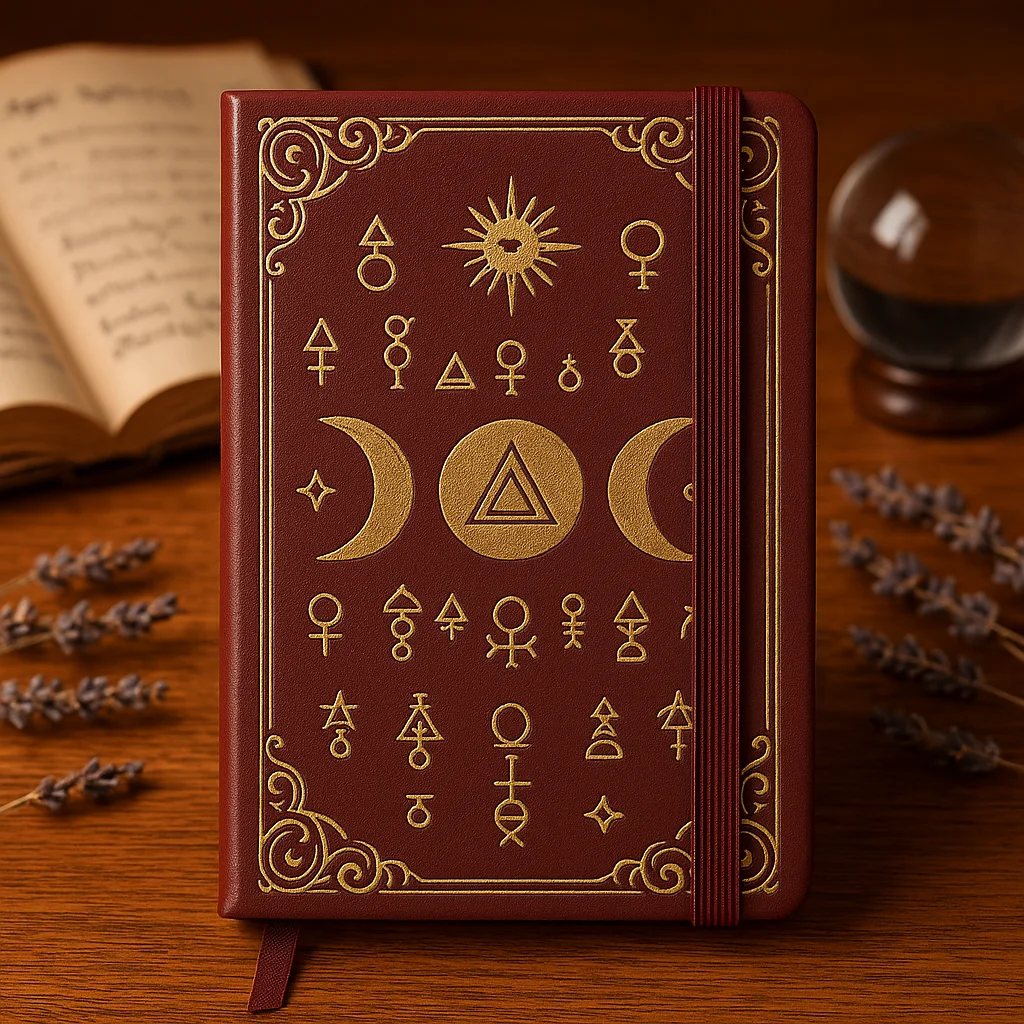
The The “Arcane Eclipse” Journal shows how a notebook can be built around a clear theme rather than a generic style.
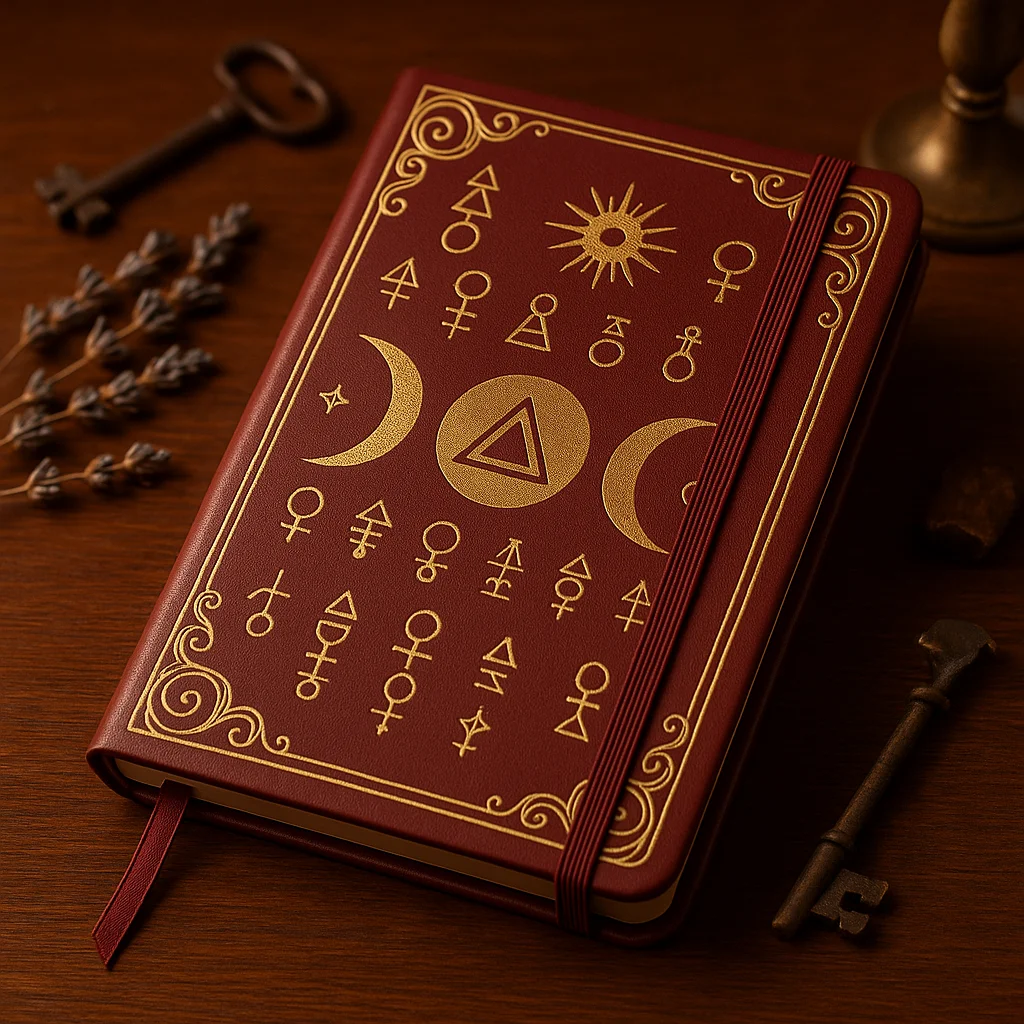
Its deep red vegan leather cover uses gold foil moon phases, celestial symbols, and alchemical details. A matching elastic closure and ribbon bookmark keep the design consistent, while rounded corners make daily handling easier. The ivory pages support journaling, creative writing, study notes, and sketching.
This kind of product gives a new business a defined audience. You could target people interested in astronomy-inspired design, fantasy writing, personal reflection, or unusual gifts. The product is not trying to compete with every basic notebook on price. It gives the customer a specific reason to remember it.
Focused First-SKU Range
Your first range should stay narrow.
One size, one binding structure, and one main page format are enough for an early launch. You may add two related cover colors, but avoid producing separate versions in every size and layout.
A focused range helps you read customer behavior. When one version sells faster, you can see whether the difference comes from color, theme, paper, or price. With ten unrelated products, that feedback becomes harder to use.
You can review a wider notebook and journal portfolio when you are ready to add gift sets, planner folios, accessories, or another notebook structure.
Product Validation and Custom Specifications
Once the concept is clear, turn it into a written product specification. A good idea still needs to work as a real object that can survive shipping, repeated opening, and daily writing.
Demand Research and Sample Testing
Read customer reviews in your target market. Pay close attention to repeated complaints about thin paper, ink bleed, weak binding, loose elastic, damaged corners, inaccurate colors, or poor packaging.
Then request a physical sample. Do not approve bulk production from a digital image alone.
Check the cover under natural light. Test several pens on the inner pages. Open the notebook flat and inspect the spine. Measure the finished size. Review the gold foil edges, ribbon length, elastic tension, trimming, corners, and packaging.
Your sample should become the physical standard for production. Keep written notes and photographs of every approved detail.
Size, Paper, and Page Layout
A5 works well for many journals because it offers useful writing space without feeling bulky. B5 gives more room for study notes and diagrams. A6 suits short notes and small bags.
The page layout should match the use. Ruled pages suit meetings and everyday writing. Blank pages work for drawing and free writing. Dotted pages support planning without forcing a fixed structure. Grid pages help with charts, diagrams, and organized notes.
The custom notebook production process includes common notebook sizes, page layouts, cover materials, logo methods, and accessory choices. Use these options to build a product around customer needs rather than adding features at random.
Cover Finishing and Functional Details
Cover finishing affects both cost and market position.
Gold foil works well when the design needs sharp contrast and a gift-like finish. Debossing produces a quieter result. Printed artwork allows more colors. Embroidery adds texture, while a metal logo can create a formal look.
Functional details should earn their place. A ribbon marks the current page. An elastic band keeps the notebook closed inside a bag. A back pocket holds loose notes. Rounded corners reduce wear.
The “Arcane Eclipse” Journal uses a small group of coordinated details instead of adding every available option. That is a useful rule for a first product. Choose what supports the theme, daily use, and target price.
Startup Costs and Pricing Structure
A notebook may look profitable when you compare its selling price with the factory quote. That calculation is incomplete. You need the full cost of getting one sellable unit into the customer’s hands.
Landed Cost Calculation
Your landed cost can include the notebook, custom printing, foil, packaging, samples, inspection, freight, import charges, storage, transaction fees, and damaged products.
Use this basic formula:
Landed cost per unit = total production and import costs ÷ sellable units
Do not divide by the full order quantity if some pieces will be used for photography, samples, quality checks, replacements, or promotion.
Ask for optional items to be listed separately in the quotation. You can then see whether a special box, thicker paper, extra ribbon, or complex foil pattern adds enough value to justify its cost.
Margin-Based Retail Pricing
Your gross margin can be calculated as:
Gross margin = (selling price − landed cost) ÷ selling price × 100%
That margin still has to cover sales fees, advertising, fulfilment, discounts, returns, and customer support.
Do not copy another seller’s price without checking your own costs. Their order size, packaging, shipping method, or product quality may be different.
A themed journal can often support a stronger price than a basic notebook, but the customer must see the difference. Clear product photos, accurate specifications, paper quality, and good packaging all help support that value.
Low-Risk Inventory Planning
A larger order may reduce the unit price, but it also ties up more cash.
Use samples, waiting lists, small buyer surveys, or preorders before investing in several versions. Track weekly sales and set a reorder point based on production and shipping time.
Your aim is not to buy the cheapest notebook possible. It is to keep enough stock for real demand without holding months of slow-moving products.
Supplier Selection and Sales Channels
Your supplier choice and sales plan need to support the same product position. A well-designed journal will still fail if later orders arrive with different paper, weak binding, or poor color matching.
Manufacturing and Quality Checks
Ask the supplier whether it can meet your exact requirements for size, paper, cover material, binding, foil, accessories, packaging, and carton protection. Every key detail should appear in a written specification.
Labon has worked in paper notebook manufacturing since 2003 in Yiwu, China. Its range covers office notebooks, student notebooks, journals, diaries, planners, boxes, and related paper products. Available materials include PU, linen, coated paper, leatherate paper, wood-pulp paper, stone paper, watercolor paper, and cotton paper.
The company supports customized production, OEM, ODM, stock-based orders, and a sample-first ordering process. Its company information also lists FSC, BSCI, and REACH-related credentials, along with customers across Europe, the Americas, Southeast Asia, and other markets. More details about its history and production background are available through the notebook manufacturer profile.
For a new business, the useful point is not just product variety. You need a factory that can record the approved details, inspect production, and support repeat orders without changing the product.
Direct-to-Consumer Sales
Your product page should answer basic questions without forcing the buyer to contact you.
Show the closed cover, open pages, spine, corners, paper color, foil detail, ribbon, elastic closure, and packaging. List the size, page count, page layout, cover material, paper information, and included accessories.
Use specific phrases that fit the product. Celestial journal, alchemy journal, gold foil writing journal, and A5 themed notebook are clearer than general wording.
Customer questions are useful product data. If buyers keep asking about paper thickness, gift packaging, or refill options, those details may need more attention in your next version.
Wholesale and Gift-Set Expansion
Once the journal has stable retail sales, you can adapt the same structure for wholesale or project orders.
A different logo, printed insert, belly band, box, or color can turn the product into a shop-exclusive item, event gift, cultural souvenir, or company present.
The available custom notebook gift set solutions include souvenir notebook sets, company anniversary sets, and museum gift sets. This gives you a route from one tested journal to a higher-value packaged offer without rebuilding the whole product.
Start Your Custom Notebook Project with Labon
When your target buyer, design direction, and price range are clear, you are ready to discuss a sample. A useful inquiry should contain enough information for the supplier to quote the correct product.
Custom Journal Development Support
Prepare a short product brief with your target market, notebook use, size, page layout, paper preference, cover material, artwork, finishing, accessories, packaging, expected quantity, and delivery window.
You can use The “Arcane Eclipse” Journal as a reference for celestial artwork, gold foil, a coordinated elastic closure, and a ribbon bookmark. Your own product should still have a distinct design and clear customer group.
Sample-to-Bulk Production Workflow
Confirm the written specification before the sample is made.
When the sample arrives, check every detail and record the approved result. Review dimensions, paper, page sequence, cover color, foil placement, binding, ribbon, elastic, packaging, and carton protection.
Bulk production should follow the approved sample and final specification. Ask how incoming materials, production stages, and finished goods will be checked.
Quotation and Project Consultation
A detailed inquiry gets a more useful answer than asking only for the lowest price.
You can contact Labon for a custom journal quotation with your target market, notebook size, page format, cover concept, quantity, packaging request, and sample deadline. This gives the production team enough information to discuss the right structure instead of guessing.
Conclusion
Starting a notebook business is easier when you keep the first launch focused. Choose one buyer group, one clear use case, and one product that has a reason to exist.
Test a physical sample, calculate the full landed cost, and keep your first inventory controlled. The “Arcane Eclipse” Journal shows how a clear theme, useful details, and consistent materials can turn a basic writing product into something easier to position and sell.
FAQ
Q1: How much inventory should you order for a new notebook business?
A1: Start with the smallest practical order that lets you test real demand while keeping enough stock for normal sales and replacements.
Q2: Which notebook size works best for a first journal product?
A2: A5 is a practical choice for many journal products because it provides useful writing space while remaining portable.
Q3: Do you need a physical sample before bulk production?
A3: Yes, because a physical sample lets you check paper, binding, color, foil, accessories, size, and packaging before approving the full order.
Q4: How should you price a themed journal?
A4: Calculate the complete landed cost first, then add enough margin to cover selling fees, fulfilment, advertising, discounts, returns, and operating costs.
Q5: Can one journal design be adapted for wholesale and gift orders?
A5: Yes, the same core structure can use different logos, inserts, colors, belly bands, boxes, or accessories for retail, wholesale, events, and gift projects.