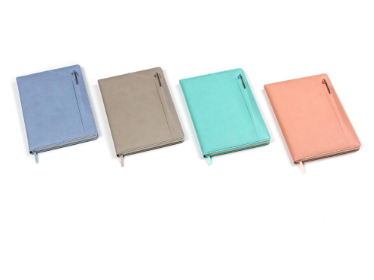
Notebook paper is often described by a short label such as wood pulp, coated, stone, watercolor, or cotton paper. That label helps start a conversation, but it does not tell a buyer everything about the finished page. Surface, opacity, weight, absorbency, printing response, and intended pen can change the product experience just as much as the paper family.
For a wholesale or custom notebook order, rather than trying to determine the “best” paper for all situations, it is more important to choose a paper type that will support the particular tasks of writing, artwork, binding, price point, and customer expectations for that particular notebook. For example, the paper chosen for a planner may not be suitable for a sketchbook, and a very smooth paper that is excellent for office notes with dry ink may not be suitable for wet ink.
The same considerations also impact manufacturing, because different papers produce books of different thicknesses, with different spines, and that have to be trimmed and folded differently. Print density also changes. Weighing packed books can be a problem too, because of the number of pages that safely fit in a book. Defining the intended use first, comparing different papers within a controlled set, and then selecting the final paper within a completed notebook is the safest course of action.
What Are the Main Types of Notebook Paper?
Common notebook paper types include conventional wood pulp paper, stone paper, coated paper, watercolor paper, and cotton paper. These categories can overlap with different weights, finishes, and suppliers, so the name should be paired with a clear sample and specification.
Conventional Wood Pulp Paper
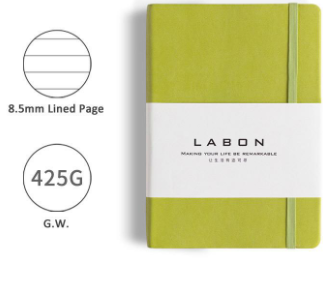
Wood pulp paper is used for most ‘standard’ writing papers, such as notebooks, notebooks for planners and diaries and general office use. In these instances the practical properties depend upon the specific grade, weight and surface finish, as well as production process. Therefore the properties such as smoothness, opacity and show-through need to be tested even within a ‘paper family’ and the print properties also assessed.
A simple paper might be the best choice for a very large volume of everyday notes. Heavy ink, lots of color or even a premium gift item require a more thorough review of the paper in relation to the complete design of the notebook.
Stone Paper
Stone paper is a paper that many brands select for reasons of creating a specific material story or for a specific surface quality. We recommend testing writing and print behavior with the intended writing tool and artwork. Environmental qualities of a paper do not automatically qualify it for use in all types of notebooks.
Get more information about the selected grade, surface, folding behavior, binding behavior and about disposal or claim language that you can back up. Also keep the wording of any material benefit marketed for the actual paper strictly in line with the supplied evidence.
Coated Paper
A coated paper provides good reproduction of images, strong colors and a smooth printed surface. This type of paper is suitable for use as covers, inserts, illustrated pages or notebooks. The writing characteristics of coated papers can be different from those of an uncoated paper, particularly with pencil, gel pens or fountain pens.
Will users write on the coated side of the sheet? Does the ink dry fast enough? Will the surface rub against other items during packing? A high-contrast printed planner looks great on screen but is very difficult to use when the surface does not work with the user’s chosen writing instrument.
Watercolor and Cotton Paper
For the purpose of a specific task, watercolor paper is different from regular note paper. It needs a surface and a structure to hold the water, the pigments and to withstand being reused. Cotton paper can provide a unique tactile quality and a distinct writing experience. However, the experience depends on a number of factors, including the blend, the texture, the weight and how it is used.
Specialty sheets can greatly change the thickness of a notebook as well as its price. Test the sheet in the final binding and cover and not as a loose sample. A sheet that prints well can still make a book too thick or too heavy for distribution through a particular channel.
Paper Type by Notebook Application
Use case is the most reliable way to narrow down your paper choices.
Planners and Office Notebooks
For note taking on both sides of the page, planners require print to read clearly, writing to be comfortable and opacity to be sufficient. A smooth conventional print sheet may be suitable for printed grid pages and daily pages, whereas a coated print sheet may be more suitable for the image heavy divider pages rather than the writing pages.
An office notebook needs to withstand constant opening and closing, throwing in a bag between locations and subjected to frantic writing. It needs good pen response, quick drying, easy turning of pages and minimal show-through. A premium feeling paper that smears with a normal gel pen will probably get more complaints than a straightforward and reliable basic paper.
Journals and Premium Retail Books
For journal buyers, the hand feel, the page color, opacity and sound are as important as the writing performance. Decide whether your product should be crisp, soft, rough to the touch or substantial and make sure the cover and packaging of your journal support the paper and do not promise anything that the material cannot fulfill.
Please review the Labon notebook portfolio for different product formats before locking the paper, as a hard journal, soft notebook, coil book and gift set could have different page-blocks even if the same paper name is used.
The Labon Softcover PU Notebook is a useful reference to how paper can affect the flexibility of a notebook. For new projects, the published page count does not tell you the paper for that project, so request to be told the exact paper type, weight and how it writes for any custom order.
Creative and Specialty Notebooks
Drawing, watercolor, lettering and mixed media products need to be tested with the same methods as their customers work. Test the pencil, marker, brush, eraser or ink you selected. Test for bleed, feathering, buckling, drying time and surface damage. If you are marketing a notebook as a creative tool, a general writing test is not sufficient.
Paper Performance and Printing Checks
When selecting paper, test both the writing and manufacturing qualities.
Opacity and Show-Through
Test printed as well as handwritten pages under normal indoor lighting. Pay attention to other text, lines or colors printed on the reverse side of the page that may detract from your writing. When both sides of a page are to be used by your customer, strong show-through reduces your pages’ effective capacity and can render a high page count worthless.
Surface and Ink Behavior
Use representative pens instead of one ‘ideal’ pen. This includes comparing ballpoint, gel, pencil, marker and fountain pen wherever relevant. Record the dry time and any instances of smearing or feathering as well as how the surface feels during prolonged writing. What may seem like a small point in a short sentence can reveal serious problems when written over many pages.
Print Registration and Folding
Carefully check fine rules, light tints, image edges and color blocks at top, center and bottom of page. A folded signature must maintain the correct placement of all artwork after trimming. A page that looks right on a flat proof may move around when folded or bound.
The published production process of Labon is a useful guide to organize discussions about design, sampling and production. It is wise to ask the supplier for the reference of the paper that has been used for the sample and to attach this reference to the final artwork so it will not be changed for repeat orders with an alternative non approved sheet.
How to Specify Notebook Paper for a Quote
Create a useful paper brief by outlining the material family, weight, color, finish, size, ruling or artwork for individual pages, printing coverage, written pen, binding, page count and packaging requirements. Can paper be written on both sides? Are there any color inserts required? Will be used with watercolor? Is there a specific retailer requirement?
Request 2-3 controlled alternatives. Test 1 variable at a time. For example, compare different weights of a given conventional paper stock. Compare uncoated vs. coated paper while keeping cover, page count and printing variables constant. The cost / performance differential is so much easier to explain in these controlled test scenarios.
Ask for a complete bound sample. Swatches are supplied loose and they do not give any indication of how the chosen paper will perform with respect to the spine, opening, page turning and packaging. Record the thickness and weight of the completed sample and note for future orders.
Use a simple scorecard to compare paper alternatives. Create a new line for each sample to rate writing, dry time, show-through, print, fold, bind, surface mark and package fit. Add the material and freight effect of low unit price papers last – they may hide problems that result in returns or customer complaints.
Also make sure to clearly distinguish the transition pages to other types of paper, like coated dividers, watercolor inserts or opening pages. These might require a different treatment than the main writing block. Check the sequence, page count and thickness of the inserts after binding, as they can change the spine and how the cover closes.
A copy of the approved paper swatch sample should be retained with the bound sample and the relevant purchase order. A record should be kept of the supplier reference, the color, weight, surface finish and intended use. For subsequent repeat orders of approved products, where a substitution is proposed, the substituted paper should be compared with the retained sample and all the writing and print checks re-completed before the artwork is packaged up and sent to press.
Projects that need a paper recommendation should send the complete brief via the contact page of the Labon website. This brief should include information about the user’s pen, the page layout, the printing coverage, the cover and the binding, as well as the quantity to be produced and the address where it will be used in order to receive an adequate suggestion in relation to the corresponding product.
Make sure that the decision on paper does not get separated from the commercial brief. The weight of the paper can affect the spine, the carton count, the freight and even the retail price. So ensure that all alternatives are quoted on the same page count and cover and that you are given the effect of the heavier or specialty paper. This will allow you to compare like with like and explain your choice to the buying team.
For repeat orders keep a retained sheet from the approved batch against the subsequent production samples. Even when the artwork has not changed, papers can show up in slightly different shades and surfaces and also in terms of stiffness. It’s much cheaper to check these against the approved samples prior to packing as opposed to discovering changes to the material after they’ve been delivered to retail or to an event.
When several factories are quoting the same paper family it can also be very useful to compare them. Ask the suppliers to specify the exact grade and finish of the sample that was provided.
Discuss Paper Options With Labon
Yiwu Labon Stationery Co., Ltd. manufactures paper notebooks and related paper products, Customized production, OEM and ODM are also available. Conventional wood pulp, stone, coated, watercolor and cotton paper directions are provided as source material, while PU, linen, coated paper and leatherate paper covers are available.
That range gives buyers a basis for discussing paper and product structure together. It does not mean every combination is suitable for every pen, finish, or binding. Send the use case, paper target, cover, page count, printing, binding, quantity, packaging, and destination through the Labon contact page.
Labon’s normal ordering process is to start with a sample and then order in larger quantities once the sample has been confirmed. The sample should be used to approve the writing surface, print, page sequence, finished dimensions and package. Keep a copy of the paper reference approved against your purchase specification.
The Labon home page is something to refer back to when comparing out the different directions of notebook, journal, planner and gift-set before the paper brief is finalized.
Conclusion
There are many more types of notebook paper than one might suspect at first glance. In addition to conventional wood pulp paper there are also stone paper, coated paper, watercolor paper and even cotton paper. The most suitable type of paper must first be chosen from the actual use case, then tested with the respective tools and finally approved in the finished notebook before it is produced in large quantities.
FAQ
What Is the Best Type of Paper for a Writing Notebook?
Choosing paper depends on many factors, including the pen you will use, your frequency of writing, surface preference, desired opacity, number of pages and your price range. A complete sample is far more helpful than a paper name.
Is Coated Paper Good for Notebooks?
While coated paper is great for print applications such as crisp images and high quality reproductions, it is best to test the paper’s writing properties as well as its drying time using the intended writing instrument.
What Is Stone Paper Used for in Notebooks?
Stone paper is often chosen for its unique look and feel, but it is crucial to test writeability, printability, foldability, bindability and eco-friendliness of the environmental statement.
Is Watercolor Paper the Same as Regular Notebook Paper?
Watercolor paper is designed for a different purpose and must be tested under the same conditions of water, pigments and binding as it is intended to be used.
How Should Notebook Paper Be Approved Before Bulk Production?
Approve a bound sample of final paper for printing, cover, binding etc. including page count and overall package. Record reference to paper and writing test results.