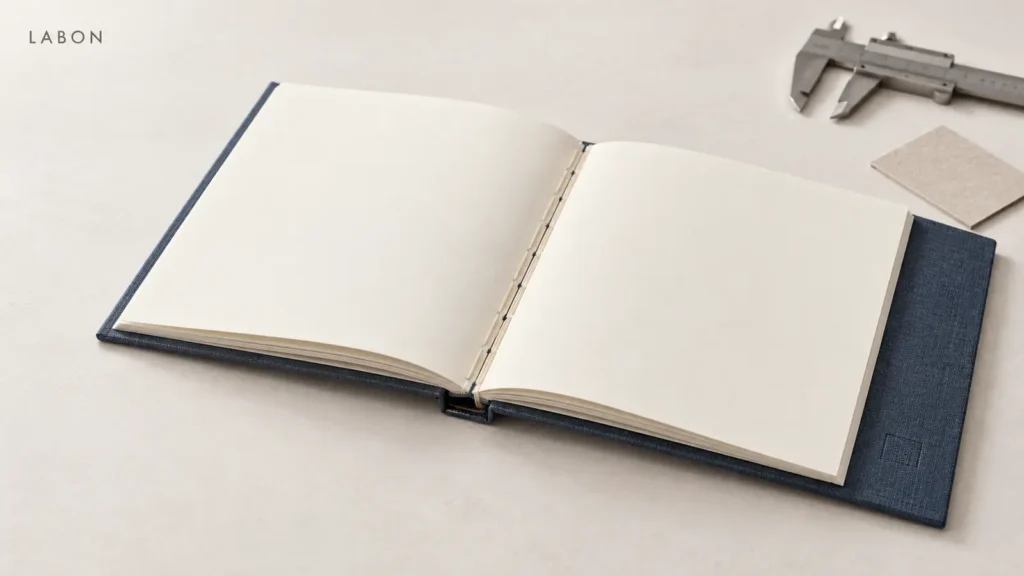
“Lay flat” is one of the most useful promises a notebook brand can make. Buyers may mean a journal that stays open for writing, a planner that can fold back on itself, or a premium book that opens comfortably across a two-page spread.
For a private-label notebook, the practical question is not whether a supplier uses the phrase lay-flat. It is whether the chosen binding, paper, cover and page design have been specified and tested for the way the finished product will be used. A short, precise brief makes sampling faster and gives quality control something real to inspect before bulk production.
Lay-flat is a user outcome, not a binding name
A notebook can open comfortably because it is thread-sewn in folded sections, because it uses a free-spine or Swiss-style construction, or because it is wire-bound. Each option looks, feels and performs differently. A conventional perfect-bound softcover can be suitable for many products, but it should not be assumed to give the same writing experience as a section-sewn journal.
Start with the spread the customer will use most. A dot-grid journal needs a usable centre gutter for drawing across two pages. A dated planner may need repeated opening at tabbed monthly sections. A corporate notebook may need a polished hardcover that can sit open during a meeting.
Choose the construction by use
Thread-sewn, section-bound hardcover journals
In a section-sewn book, the text block is made from folded signatures that are sewn together before the book is cased into its cover. This construction is a strong choice when the product needs a premium hardcover feel, frequent use and a comfortable two-page writing spread. It is especially relevant for guided journals, reading journals and high-page-count planners.
Ask the supplier to show the intended construction in the physical sample, not only in a rendering. The sample should open naturally near the front, centre and back of the book, and the cover hinge should not pull the text block or crack under normal handling.
Free-spine or Swiss-style formats
These constructions separate the cover boards from the spine area, allowing the book to open with less resistance. They can suit design-led notebooks where the visible spine treatment is part of the product story. The key is to approve the actual finished cover, because the open-spine appearance, board alignment and protection of the text block are all visible details.
Wire-O and coil planners
Wire-bound notebooks can open fully flat and fold back, which is useful for planners, workbooks and desk-based note-taking. The trade-off is visible hardware and punched margins. Confirm the wire diameter, hole position, page-turning clearance and how the coil affects the final packaging size. For a direct comparison of two common formats, see spiral versus perfect binding for notebooks.
Perfect-bound softcovers
Perfect binding may still be the right commercial choice for a softcover notebook, especially where a clean spine and a particular price position matter. But buyers should test it rather than use “lay flat” as an automatic expectation. If writing across the gutter is essential, state that requirement and judge the actual sample at the relevant spreads.
Turn “lay flat” into a production-ready specification
A quote request becomes more reliable when it includes the details below. They also help a supplier select the right materials before artwork is finalised.
- Format and use: State the finished size, orientation and main writing behaviour. “A5 dot-grid journal for two-page spreads” is more useful than “premium notebook.”
- Binding construction: Name the preferred method—such as section-sewn hardcover, free-spine construction, Wire-O or perfect binding—and ask for alternatives only if the intended use stays the same.
- Page count: Give the count in pages and, where helpful, sheets. The text-block thickness affects the spine, cover fit and packaging dimensions.
- Paper: Specify the selected stock, GSM, colour, ruling or dot grid, and any pen test that matters to the brand. Paper thickness and stiffness influence both the feel of the book and the opening behaviour. Our guide to paper for premium custom journals explains the paper checks worth making before production.
- Interior design: Mark any maps, trackers, images or tables that cross the centre gutter. Avoid placing essential small text directly on the fold unless it has been proved readable in the sample.
- Cover and hinge: Confirm cover board, wrap material, hinge treatment and any elastic, pen loop or ribbon that could affect the way the book opens or fits into a box.
Use the same version of this brief for quotation, artwork confirmation and sample review. The broader custom printed notebook specification should record the visible cover, interior and packaging decisions alongside the binding choice.
Make the sample approval objective
“It feels good” is useful feedback, but it is not enough to guide a production run. Agree on a short opening test before the sample is approved.
- Open three locations. Check a spread near the front, the centre and near the back under normal writing pressure—not by forcing the cover flat.
- Check the usable gutter. Write, draw or read the most gutter-sensitive layout. Confirm that the centre fold does not hide important text or make the spread awkward to use.
- Repeat the motion. Open and close the notebook several times, then inspect the hinge, sewing, glue areas and page alignment for stress or movement.
- Review the complete unit. Test the notebook after it has been placed in and removed from its intended sleeve, rigid box or mailer. A tight packout can change the way a cover and spine recover after handling.
- Keep the accepted sample. Photograph the agreed spreads and retain the physical sample with the final specification. It becomes the reference for pre-shipment inspection.
These checks fit naturally into a custom notebook sample approval checklist. They also stop a common misunderstanding: approving a beautiful closed book, then discovering that the pages near the beginning and end do not offer the writing experience described on the product page.
When a lay-flat construction earns its place
Lay-flat performance matters most when the user spends time on a two-page spread: bullet journals, planners, recipe books, study notebooks, training workbooks and notebooks used for drawing or meeting notes. It can also support a premium retail position because the opening experience is felt immediately by the customer.
It is not a substitute for choosing suitable paper, an appropriate page count or a durable cover. A beautifully sewn journal can still feel wrong if the paper is too light for the intended pen, the printed layout ignores the gutter, or the gift box puts pressure on the corners. Treat the binding as one part of the product system.
FAQ
Does thread-sewn automatically mean a notebook will open 180 degrees?
No. Thread sewing is an important construction choice, but the final opening depends on the signatures, cover and hinge design, paper thickness and the particular spread being opened. Approve the physical sample instead of relying on the term alone.
How should I write the requirement in an inquiry?
Describe the use and the acceptance test: for example, “A5 hardcover dot-grid journal, section-sewn construction preferred, intended to stay comfortably open for writing across a two-page spread; please show the opening at front, centre and back in the sample.”
Can a high-page-count notebook still be lay-flat?
It can, but page count affects text-block thickness, spine design, cover fit and packaging. Share the paper specification and target page count early so the construction can be sampled as a complete product rather than guessed from a cover drawing.
Specify the writing experience before the sample is made
A clear lay-flat brief protects both the user experience and the production decision. If you are developing a custom journal, planner or premium notebook, send LABON your target size, page count, paper, cover idea and intended use for a practical construction review before sampling.