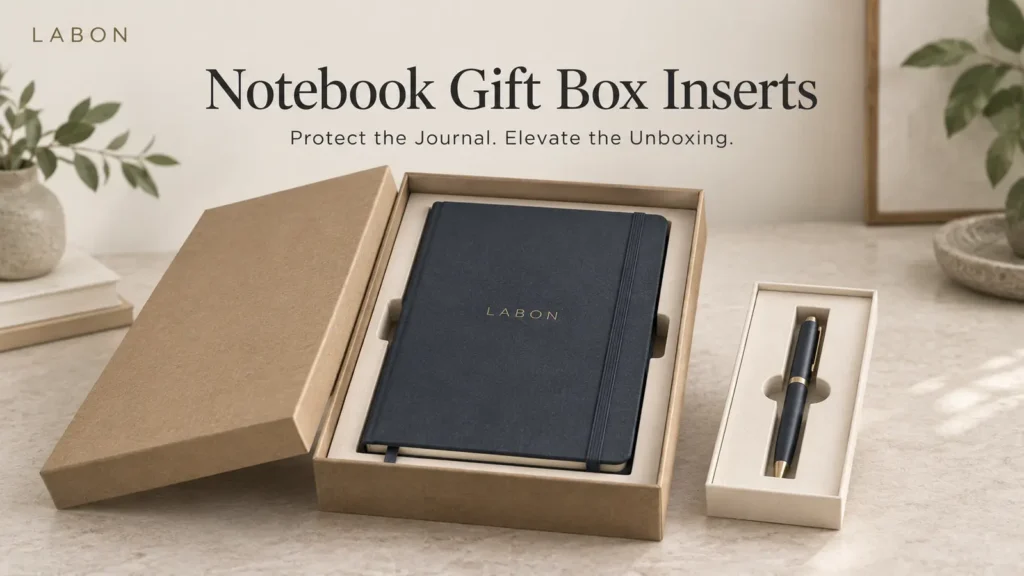
A rigid gift box can look impeccable at sample approval and still leave a bright rub mark on a dark journal cover after delivery. Sometimes the problem is not the outer box at all. It is the insert: the part chosen to keep the notebook in place.
For a private-label journal or planner, a good insert has two jobs that pull in different directions. It must restrain the product during handling, yet let the customer lift it out without scraping the cover, tugging on a ribbon or pressing on a foil logo. That balance is worth specifying before anyone quotes a box.
Begin with the finished notebook, not an A5 outline
“A5 notebook with a pen” is not a box drawing. The actual unit has a measured width, height and spine; rounded corners, an elastic closure, a pen loop or a thick ribbon may extend beyond those dimensions. A 200-sheet edition will not necessarily share the same cavity as a lighter edition, even if the front cover is identical.
Send the packaging supplier the finished, bound sample or its measured dimensions. Mark the surface that customers will see first and any area that must not touch the insert: a foil-stamped title, a cloth weave that snags easily, a soft-touch coating or a printed edge. Decide whether the notebook should sit flush, be raised for a reveal, or have room for an information card. No single clearance figure works for every cover and insert construction; the approved sample must determine the fit.
Choose the insert around its contact points
Folded paperboard for a restrained, paper-led presentation
A folded paperboard tray can hold a journal by its sides and give the box a clean, coordinated look. Its surface may be printed to match the cover or left quiet so the notebook remains the focus. A thumb recess, lift tab or removable support can make extraction easier without adding a loose accessory.
Paperboard is not automatically gentle. An exposed die-cut edge can rub a delicate cover, while an over-tight folded wall can compress a soft case or curl a corner. Ask where the board touches the product when the lid is closed, not just where it touches in an open-box photograph. If the design relies on tissue or a sleeve between surfaces, include that layer in both the drawing and the quotation.
Foam when the set needs shaped, separated cavities
A cut foam insert may be useful when a journal shares the box with a pen, a clip or another object that should not move independently. Cavity shape and depth can keep those items apart. A lining or wrap may be needed where a visible cover rests against the foam; approve the actual contact material rather than a rendering of it.
Foam also changes the object you are buying. Specify its thickness, cavity shape, exposed edges, surface finish and whether it is glued or removable. A deep cavity may protect the journal yet make it awkward to lift out; a shallow one may let the pen climb onto the cover. This is a design trade-off, not a default upgrade over paperboard.
Keep hardware and decoration out of the pressure path
The most useful drawing is often a side section rather than another top-view mockup. It shows where the lid, insert and book meet when the box is shut. For a foil-stamped or shallow-debossed cover, keep a retaining flap from bearing directly on the logo. For a clothbound journal, check whether any raw board edge catches the weave as the book is removed. A protruding elastic or pen loop needs its own space instead of being flattened to make the lid close.
In a notebook-and-pen gift set, give the pen a distinct pocket or restraint and check its clip and tip cannot contact the cover. Test the way a customer actually opens the box: can they lift the notebook by its edge, or are they forced to pull a ribbon bookmark? A neat-looking box that requires the wrong motion is not finished packaging.
Test the assembled set, then the route it will travel
Approve the journal, insert, box and any tissue or sleeve together. Close the lid, turn the box gently in several directions, reopen it and note whether the journal has shifted. Remove and replace it repeatedly, then inspect the cover under angled light for scuffs, compressed corners, foil transfer or marks from the pen. Photograph both the approved fit and any areas you do not accept. These are practical sample checks, not a substitute for transit testing.
Pack the approved gift box in the intended shipping carton and protective arrangement. FedEx’s packaging-engineer guidance recommends protecting the vulnerable part of a product and separating multiple items when needed. For parcel programmes that warrant formal validation, the ISTA test-procedure guidance helps a packaging team select an appropriate distribution test; do not describe an untested set as “ISTA tested.”
For Amazon fulfilment, confirm the current marketplace requirements for the sellable unit, its labels and its outer pack before approving artwork. Our FBA notebook packaging guide covers that handoff in more detail.
Request comparable quotes for the complete insert
Two insert prices are not comparable if one covers only a cut blank and the other includes lining, assembly and packing. Ask suppliers to describe the substrate, board or foam thickness, cut geometry, printed or wrapped finish, tool charges where applicable, hand assembly, protective layers and the finished box dimensions. Include the target quantity and each version of the journal; small changes in spine or pen position can require a different cavity.
Also ask how the packed set will be arranged in the master carton. An insert that increases gift-box depth changes the shipping cube, while an elaborate tray can slow repeatable assembly. For a new retail line, it is reasonable to compare two physical directions—perhaps a paperboard tray and a wrapped foam insert—against the same notebook and acceptance notes. The lowest insert-only price need not be the best unit packout.
A brief that makes approval possible
Before sampling, put these details in one document:
- Finished notebook dimensions and version, including spine, closures, ribbons and page-count variants.
- Cover material, logo treatment and any no-contact surfaces or scuff-sensitive areas.
- Every set component and its intended position, especially pens or metal accessories.
- Box structure, reveal height, removal method and protective layers.
- Sales and distribution route, target quantity, SKUs and expected outer-carton arrangement.
- Photos or notes showing what the physical sample must pass before bulk release.
That brief is narrower than a general gift-set request. For the wider supplier decision, see what to check in a custom journal gift-set supplier. Once the components are made, carry the final fit and finish into the notebook sample approval record.
Questions buyers ask
Can a paperboard insert replace foam in a premium notebook gift box?
Often it can, if the folded structure restrains the finished journal and any accessories without marking the cover. Do not choose by appearance alone: compare both physical packouts using the same notebook and shipping arrangement.
Does a tighter insert protect the journal better?
Not necessarily. Too much pressure can mark a soft cover, bend corners or make removal difficult. The objective is controlled movement and safe extraction, with the final carton providing the protection appropriate to the route.
Should the gift box sample be approved without its notebook?
No. A flat dieline or empty box cannot establish clearance, rubbing or the opening experience. Approve the assembled set, including the actual cover finish and any protective layer.
Developing a custom journal or notebook gift set? Send LABON the finished size, cover and logo details, set components, quantity and destination. We can review the brief and discuss a sample that checks the notebook and box together.