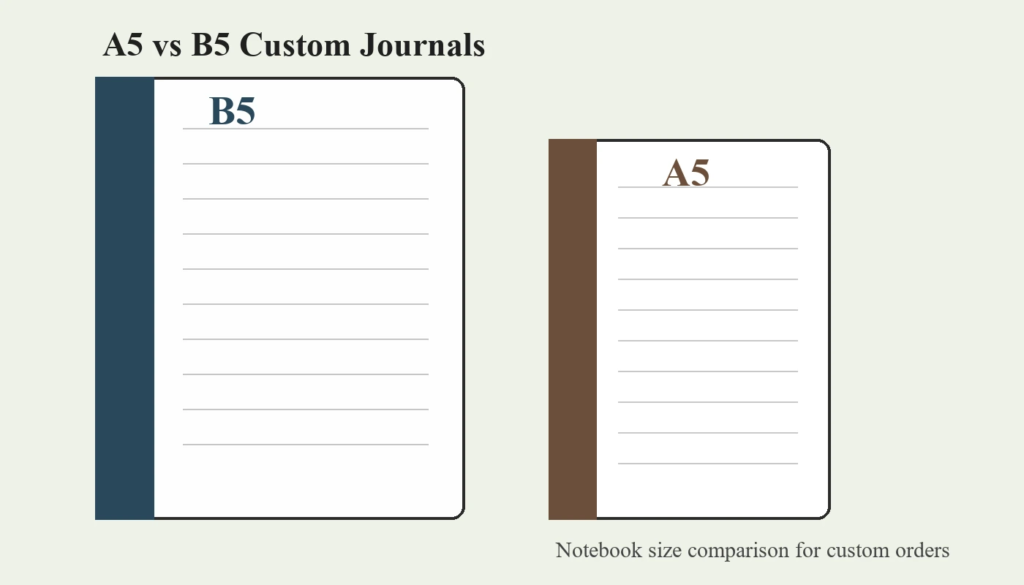
Choosing between A5 and B5 looks simple on a specification sheet, yet it changes how a custom journal feels from the moment someone picks it up. Size affects writing space, portability, cover proportions, paper use, packing, and shipping weight. A notebook can have good paper and a well-made cover and still feel wrong when its format does not suit the people receiving it.
A5 is compact enough for commuting, meetings, and everyday notes. B5 gives you more room for study pages, project planning, sketches, and longer records. That does not make one size better in every order. A business gift carried between meetings has a different job from a workbook that stays on a desk.
Before you approve artwork or choose a cover finish, decide where the journal will be used and how much space the user really needs. That one decision makes later choices easier, including page count, paper GSM, packaging, carton size, and target price. It also gives your supplier a clearer starting point for samples.
How Does Notebook Size Affect a Bulk Custom Journal Order?
Notebook size affects hand feel, writing area, paper use, cover layout, carton packing, and daily carrying. Compare A5 and B5 with the same construction so the format remains the only changing variable.
End Use, Writing Area, and Order Cost
A5 fits many bags, drawers, desks, and meeting rooms, while B5 provides more room for notes, sketches, planning pages, and study layouts. The purchasing effect goes beyond user preference. Size changes paper consumption, cover-board area, carton space, and shipping weight. Ask the supplier to quote both formats with the same page count, paper GSM, cover material, binding, and packing method so the comparison isolates the size difference.
Approximate Page Area Difference
| Factor | A5 | B5 |
| Typical Dimensions | 148 × 210 mm | ISO B5: 176 × 250 mm; JIS B5: 182 × 257 mm |
| Portability | Easier to carry | Better for desk use |
| Approx. Page Area | 31,080 mm² | ISO B5: 44,000 mm²; JIS B5: 46,774 mm² |
| Gift Packaging | Smaller box or sleeve, all other specifications being equal | Larger box usually required, all other specifications being equal |
| Paper Consumption | Lower, when page count and paper GSM are the same | Higher, when page count and paper GSM are the same |
| Best Use | Meetings, events, and gifts | Study, planning, and desk work |
| Buyer Risk | Limited writing room | Higher weight and packing cost, all other specifications being equal |
ISO B5 provides about 42% more page area than A5, while JIS B5 provides about 50% more. These figures compare full sheet area; usable writing area is lower after margins, headers, footers, and the spine-side safe area are deducted. For a fair A5 vs B5 notebook comparison, apply the same margin and gutter assumptions to every format. Ask the supplier to state both the finished trim size and the usable writing frame on the artwork. This separates the measurable format difference from layout choices and makes quotation comparisons more reliable before physical samples are approved. The percentage is more useful in practice than saying only that B5 feels larger.
A5 Notebook Size for Daily Custom Journals
A5 is often the safer choice when the final user’s writing habit is not very clear. It is large enough for daily notes and still small enough to carry without much thought. Many buyers start with A5 when they test a new journal line because it causes fewer surprises.
The “Arcane Eclipse” Journal measures approximately 14.8 × 21 cm, making it a practical A5-size reference for custom journal projects. Buyers should still confirm the finished tolerance, page count, paper, cover, binding, logo process, and packaging on the quotation and physical sample.

Labon has produced notebooks since 2003, but the relevant proof for a size decision is the sample. Approve A5 and B5 with the same paper, page count, cover, binding, and pack so the comparison reflects format rather than a changed construction.
A5 Procurement Fit
For office buyers, A5 works well in meetings without taking much table space. For corporate gifts, it is easier to combine with a pen, card, sleeve, or compact gift box. Retail buyers also recognize the format quickly. These advantages make A5 useful when portability, distribution, and packaging efficiency matter more than maximum page area.
A5 Specs Buyers Should Confirm
For an A5 custom journal, do not stop at the size name. Put the finished size tolerance, page count, paper GSM, cover thickness, corner style, elastic band, ribbon marker, inner pocket, and individual packing into the same quote. That is where hand feel and wholesale cost start to change.
B5 Notebook Size for More Writing Space
B5 sits between compact notebooks and full desk-size books. The page feels more open, which can help with study notes, project planning, and creative work. If your customer complains that A5 feels tight, B5 is worth sampling.
B5 Procurement Fit
B5 is helpful for training projects, planning pages, project trackers, diagrams, and longer text blocks. The wider page can also create a more substantial desk product when matched with a firm cover and suitable binding. Buyers should balance that benefit against the larger gift box, carton volume, paper area, and shipping weight.
B5 Specs Buyers Should Confirm
For B5 orders, check whether the wider page needs stronger binding, thicker cover board, different carton packing, or a higher retail price. A B5 notebook can look premium, but the extra size should serve a clear writing or planning purpose.
Custom Journal Manufacturing Factors
Size must work with the cover, paper, binding, logo, and packaging. Confirm those items on the physical sample rather than treating dimensions as an isolated choice.
Labon supports OEM and ODM projects with physical sample confirmation before mass production, allowing buyers to compare A5 and B5 as finished notebooks rather than loose paper dimensions.
Cover Material Fit with Notebook Size
A larger format may need firmer cover support, while a portable A5 journal may favor a lighter construction. Test cover balance in hand rather than judging it from artwork.
Paper Selection for the Final Hand Feel
Paper GSM and caliper change text-block thickness and hand feel. Compare both formats with the same paper before changing the material specification.
Sample Approval Before Bulk Production
For bulk orders, a sample is not a formality. The production team begins custom projects with sample production and physical confirmation before bulk production. That step helps you check size before committing.
How Do A5 and B5 Change Packaging, Freight, and Quotation?
A direct A5 vs B5 comparison is useful because many buyers are choosing between these two, not between every notebook size in the world. The question is not which size is famous. The question is which size gives your buyer fewer complaints after purchase.
B5 also needs a clear size definition. ISO B5 is about 176 × 250 mm, while JIS B5 is about 182 × 257 mm. Some suppliers may also use a custom finished B5 size. Put the final width and height in millimeters on the quotation, sample label, and production file.
Paper Consumption and Production Cost
A5 uses less paper area than B5 when page count, paper GSM, and construction are the same. The difference also affects cover board, lining paper, elastic length, ribbon length, and packaging dimensions. A quote should state every shared specification so buyers can see which cost change comes from format alone.
Gift Box, Carton, and Freight Pressure
A5 normally creates a smaller pack and may allow more units per carton. B5 generally requires more carton volume and can increase shipment weight when all other specifications are equal. Buyers should request packed-product dimensions, units per carton, gross weight, and carton measurements before approving a large gift program.
Quotation Details Before Approval
When you compare quotes, line up the boring details first: paper type, GSM, page count, cover material, binding, logo process, packaging, and order quantity. If one supplier quotes A5 with thin paper and another quotes B5 with heavier paper, the price gap is not really a size comparison.
Choose Labon for Custom Notebook Size Projects
Review custom notebook size samples for proportion and construction ideas, then approve both formats physically before bulk production. The chosen size, cover, paper, binding, and pack should remain consistent with that signed sample.
Review the custom notebook manufacturing process before approval. When both format samples use matched specifications, discuss the custom journal order using the version that best fits the buyer’s real use.
Conclusion
A5 is usually better for portable custom journals, office gifts, and distribution programs that need compact packaging. B5 works better when your buyer needs more writing space or a stronger desk-use product. Compare paper area, gift-box dimensions, carton packing, freight data, and quotation details before choosing. Then match the size with cover, paper, binding, branding method, and packaging.
For many bulk buyers, the safest path is to sample both A5 and B5 before making the final call. The difference is easy to feel once the notebook is in your hand.
FAQ
Is ISO B5 the Same as JIS B5?
ISO B5 is approximately 176 × 250 mm, while JIS B5 is approximately 182 × 257 mm, so buyers should state the exact finished dimensions.
What Notebook Size Is Best for Corporate Gifts?
A5 is often the safer choice because it is easy to carry, pack, and use in office settings.
Does Notebook Size Affect Bulk Order Cost?
Yes, size can affect paper use, cover material use, carton space, shipping weight, and final unit cost.
Can Notebook Size Be Customized for Bulk Orders?
Yes, buyers can customize the finished size, page count, paper, cover, logo, and packaging. OEM/ODM customization should be confirmed through an approved sample before mass production.
Should I Sample A5 and B5 Before a Large Order?
Yes, sampling both sizes helps you check hand feel, writing space, cover balance, and packaging before bulk production.