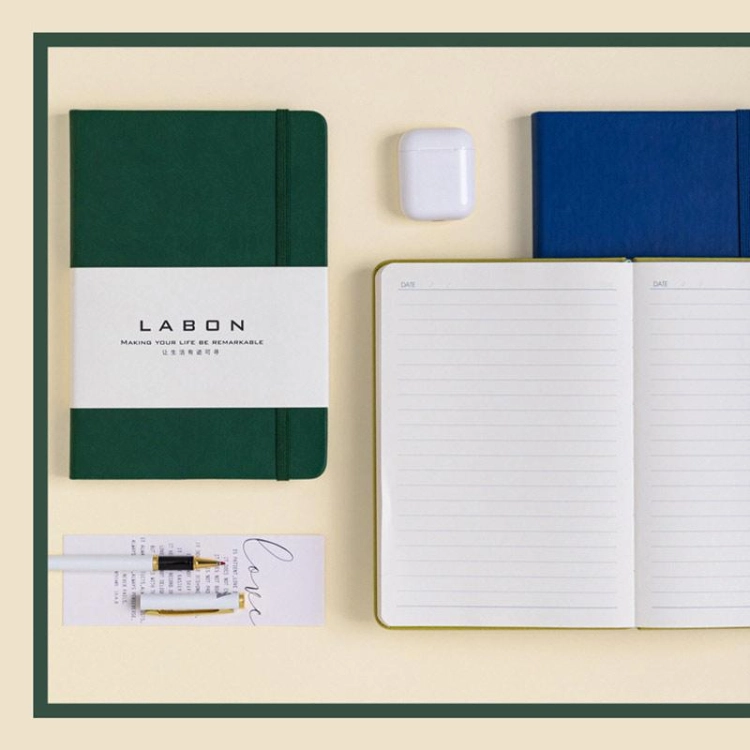
Ruled paper is not one universal layout. Wide ruled, college ruled, and narrow ruled pages place different amounts of space between writing lines, so they serve different users and notebook formats. A buyer who chooses the wrong ruling can end up with a book that looks correct in a quotation but feels awkward when customers actually write in it.
Deciding on line spacing in practice is not just about choosing the most popular option. It has to work with users’ handwriting, with the pen or pencils users have chosen, with the size of the notebook and where it sits within your product range. So a school notebook, a compact journal for retail and a meeting book for corporate users may all need ruled pages but that does not necessarily mean they should all use the same ruling.
Line spacing for custom orders can affect printed area, margins, number of pages, artwork and our quality checks. Ruling must be specified as a measurable product feature and approved on the actual printed page instead of just referring to a name.
What Is the Difference Between Wide Ruled and College Ruled Paper?
Wide ruled paper allows for more vertical space between lines. College ruled paper allows for more lines on a page than wide ruled, while narrow ruled paper is even more compact to allow writers who write with very small letters to fit more on a page. The exact spacing can vary from market to market and from supplier to supplier. Therefore, the artwork should state the exact spacing in mm instead of just calling it “narrow” or “wide”.
Wide Ruled Writing Space
Wide ruling is optimal for larger handwriting, early writing practice and users that want to have a more open page. Wide ruling allows for easier scanning since there is more space between lines. However, the notebook will fill up sooner since there is less space per page and the user writes several sentences a day.
Additional space between lines is very useful for school books and training material, enabling children to write large, making corrections and for teachers to add comments. For premium quality journals however, extra wide ruling can result in under-filled pages, especially when the cover and number of pages create certain expectations. Check the writing area against the promised page count before you choose.
College Ruled Balance
The college ruling is a middle option for many general writing products. More lines than the wide ruling, yet still sufficient space for ordinary handwriting. This type of ruling is suitable for office notes, study notebooks, meeting minutes, and retail journals, where the page is not written in large letters.
Verify the name “college ruled” is in the specifications. Get supplier to show actual line spacing, line width, margins and number of lines per page. Lines that are there but too dark or too close to the edge of the book can make even usable ruling look crowded.

Narrow Ruled Capacity
The use of narrow ruling is best when information density is a priority. This is to enable the use of small lettering, for example lists of words, technical notes and very compact planning pages. Users who write in large lettering or require space for corrections may find this type of ruling less useful.
Even narrow lines can look like very dense ink when there are a lot of them on a page. Test the page with typical writing instruments used by your audience. A fine tip ballpoint pen might feel comfortable writing on the page but a broad tip gel pen or fountain pen might make the page look too crowded.
Notebook Ruling and User Application
The line spacing of a notebook depends on its use case. You start with that and then choose ruling and page architecture to fit that use case.
School and Handwriting Products
School buyers need wide ruled pages for their younger writers and tighter ruling for their older students. If a product is intended for several age groups then provide separate versions of the product instead of trying to make one line spacing work for all users. Clearly label the cover or packaging so that buyers know what they are purchasing.
For handwriting practice, often a baseline, midline, margin or special guide system is required. These are not to be confused with wide ruling or college ruling. A full-size page proof should be supplied and all lines that are visible in the artwork identified before sampling.
Office and Meeting Notebooks
Most office users need a compromise between comfort for writing and the amount of information to be recorded. A college ruling is good for meeting notes, action lists and project reports, but the most important thing for an office notebook is a narrow margin, not to be filled with yet another line of writing. Inner space is needed to read words near the spine of the bound notebook.
A meeting notebook can be composed of ruled pages, a dated header, a project field and an action column. The writing lines should be consistent on the main page and the special templates should be treated as separate artwork. This facilitates proofreading and prevents the decorative header from cutting down the usable writing surface.
Journals and Retail Collections
Retail journals can be set up with wide, college or narrow ruling to fit your brand’s target audience. A guided journal may have fewer lines than a plain writing journal because of the space that journal prompts and check boxes take up on the page. But a plain writing journal still needs to have enough space around the edges of the page to be calm.
Check out the Labon notebook portfolio for a comparison of the hard, soft, coil, journal and planner directions. This portfolio is a starting reference only and should not be used in lieu of a ruling proof. Line spacing in the final file should be set in accordance with the chosen format, paper and binding.
For a layout-led product reference please see the Diamond Grid Planner page. This allows us to explain how a printed guide system could work within a notebook cover. Note that the Diamond Grid Planner is not a French, college or narrow ruling specification for a new order and the final line spacing would be set as part of the artwork and approved by sample as usual.
Paper, Ink, and Printed Line Control
When using ruling as a print system, the paper and ink choices affect the printed page.
Contrast and Line Weight
A ruling is supposed to guide writing. Against a light background a dark ruling may be too prominent, while a pale ruling may not be visible against a normally lit background. Specify color and tint as well as weight and printing process and test the sample in the conditions in which the notebook is to be used.
Please provide a print proof of blank and filled text. What looks to be printed to a small page in blank form may become unreadable with black print, highlighting or pencil marks added. Check the top, middle and bottom of the page for even registration.
Paper Surface and Show-Through
Feedback from writing on paper and ink absorption on paper surfaces are key factors. Smooth paper is good for fine pens, whereas rough surfaces create different writing experiences. Opacity, i.e. show-through, of paper is an important factor when users write on both sides. If show-through is too strong, the apparent capacity of a ruled notebook even decreases so that customers often leave alternate pages unused.
Labon’s source material lists conventional wood pulp, stone, coated, watercolor and cotton papers for consideration in the development of various paper types. The paper type should be discussed in relation to the intended use with a particular pen and ruling. A paper that is good for a printed planner may not be the best for a fountain-pen journal or a handwriting workbook.
Margins and Binding Clearance
Even after trimming and binding, the area to be written in the usable line area must remain clear. The top, bottom, inner and outer margins must be clearly defined in the page map. Coil books need allowance for the hole punch, glued or sewn books need to allow for writing away from the spine.
Work from the Labon production process to take your design from sample to finished production. In addition to using the Labon production process as a framework, specify project-specific tolerances within the approved file. A rule that looks good on a flat PDF may change as the paper is folded, trimmed or assembled into the final product.
How to Specify a Ruled Notebook for a Quotation
A useful request is one that allows a supplier to price and sample what you wish to order as a product.
Page Geometry
Please list the final dimensions of the completed notebook, include the page orientation, the line spacing and the number of lines per page, the margin dimensions, the color and weight of lines, any areas of bleed, and the safe area. Please distinguish between printed sides of pages and individual physical sheets. A full-size PDF or vector artwork with dimensions is preferred over a screenshot of another notebook.
Product Construction
Include details on the paper type and weight, cover material, board thickness where relevant, binding and closure details, page count and any special pages. Consider if the same ruling has been used throughout the book or if different templates have been used for certain parts of the book. The ruling should be viewed in conjunction with the spine, cover and package as each of these affects the overall dimensions of the finished book.
Sampling and Acceptance
Create a physical sample made from the proposed paper stock, page count, binding type and print quality. Write a few lines of sample text using representative pens. Check the margin near the binding edge and ensure that registration is adequate across all sheets. Store the approved sample with the final artwork for future repeat orders.
Create an acceptance sheet for the ruling measuring the line space and counting the lines, measuring the top and bottom margins as well as the inner margin and the line color. Instead of checking the opening spread only, check the first, middle and last pages. If the notebook contains dividers, indexes or even branded pages, verify that the ruling continues from the correct position after each section.
Check a closed notebook from the fore edge of the notebook as well as the open page. A subtle shift in printed lines that is hard to see on one spread may become apparent as printed lines form a solid block at the edge of the spread. For coil or punched notebooks check that the holes do not take up too much space to write around. For glued or sewn books check that the center lines are still visible after the book has been covered.
The approval record, quotation and the artwork revisions should be sent together. You can confirm any project specific sampling, materials, packaging etc. details on the Labon contact page. Having these written down will mean repeat orders of the same notebook are consistent when produced months later.
Plan Custom Ruled Notebooks With Labon
Yiwu Labon Stationery Co., Ltd. was founded in 2003 and it is a specialized paper notebooks and related paper products supplier. The products Yiwu Labon Stationery Co., Ltd. supplies include office notebooks, student notebooks, diaries, planners, journals, hard notebooks, soft notebooks, coil books, etc. The products allow for ruled pages to be combined with practical notebook forms.
Labon supports customized production of all books, including OEM and ODM production. First compare our available paper and cover directions and then request a ruled sample of your chosen finished size using the Labon contact page with the relevant information regarding your page artwork, line measurements etc and also details regarding the paper required, binding, quantity, packaging etc and destination together with your required quality checks.
Typical ordering information indicates that you start with a sample and then order in larger quantities once you have approved. When approving a notebook, don’t just check the line spacing, test out the whole user experience. Can it open comfortably? Are the lines registered? Is there enough room for your handwriting?
This home page of Labon shows an overview of all notebooks and paper products offered by the company before a detailed ruling brief is sent.
Conclusion
Wide ruled paper, college ruled paper and narrow ruled paper are all tools for different writing behaviors. Large writing requires wide ruled paper, medium sized writing is comfortable on college ruled paper and very dense notes are best written on narrow ruled paper. Choose the ruling that best fits the user and the purpose of the product and specify it in measurements. Check the finished paper and binding before placing a bulk order.
FAQ
What Is the Main Difference Between Wide Ruled and College Ruled Paper?
Wide ruled paper has more space between the lines on each page than college ruled paper. College ruled paper has more lines on each page and is ideal for small everyday writing.
Is Narrow Ruled Paper Better for Small Handwriting?
This may work well because closer lines facilitate more compact writing, but it is best to test this with the writer’s chosen writing instrument and typical letter size.
How Many Millimeters Apart Are Notebook Lines?
Spacing between lines depends on ruling system and supplier. Specify your target measurement on artwork and check on finished sample.
Which Ruling Is Best for a Meeting Notebook?
For meetings, a college ruling paper is often a sensible starting point as it allows for comfortable writing whilst conveying sufficient information. The margins and layout also need to be considered.
Can a Custom Notebook Mix Different Ruled Page Styles?
Yes. A notebook can have a mix of ruled pages, blank pages, dotted pages, dated pages and template pages. As long as the page map clearly indicates what is on each page then a mix is fine.