The production of custom notebooks follows a strict process: A written product specification is the starting point for the production of custom notebooks. After that, we select the appropriate materials, create a quote, produce a sample, approve a sample, lock in the artwork, produce the bulk order, inspect it for quality and finally pack it.
Design becomes production reference with sample-first workflow. It allows buyers to hold the notebook and manufacturers to measure the various qualities of a notebook including paper, cover, binding, print, packaging and feel. The sample is no longer a preliminary step to a design and becomes part of the manufacturing process for the notebook.
Labon Stationery supports customized production, OEM, and ODM for notebooks, journals, diaries, planners, gift boxes, gift sets, and related paper products. Its official portfolio can help buyers start the discussion with a product direction instead of a vague request.
What Is the Custom Notebook Production Process?
For most custom notebook projects, the process can be organized into eight steps: 1) define the use and specifications, 2) send artwork and references, 3) confirm quantity and commercial requirements, 4) request a quote and production sample, 5) approve the complete sample, 6) lock the final specification and begin bulk manufacturing, 7) perform quality control, and 8) confirm packaging, payment, shipping, and after-sale terms.
The exact sequence can vary by design, but the logic should stay consistent: define the product before pricing it, approve the real product before scaling it, and keep the approved sample and written specification together so the bulk notebook production process can be repeated.
Step 1: Define the Notebook Use and Specifications
State who will use the notebook, where it will be sold or distributed, and what the product must do. Office notes, school use, journaling, planning, retail resale, corporate gifting, anniversary programs, and museum souvenirs can require different sizes, page layouts, covers, paper, binding, and packaging.
Step 2: Send Artwork and Visual References
Send the logo, artwork, color references, and any physical or digital examples that communicate the intended direction. Reference images are useful for mood and layout, but the production specification still needs to define the actual materials, dimensions, printing, and finishing to be manufactured.
Step 3: Confirm Quantity, Destination, and Commercial Requirements
Include the target quantity, delivery destination, timing, and payment requirements in the brief. Labon’s knowledge base lists TT and PayPal as supported payment methods. The final quotation should also confirm the order-specific shipping terms and payment details before production starts.
How Are Custom Notebooks Specified Before Manufacturing?
Before a sample is made, translate the idea into a specification that can be checked. At minimum, define the notebook size and orientation, page count, cover structure and material, paper type, ruling or layout, binding, printing, closure, accessories, packaging, quantity, destination, and sample requirements.
Choose the Cover Material
Labon lists PU, linen, coated paper, and leatherate paper as cover materials. Each material creates a different visual and tactile direction. The production sample should show the actual cover material, color, logo treatment, and finish because digital artwork cannot confirm hand feel or surface behavior.
Choose the Paper Type and Page Layout
The knowledge base lists conventional wood pulp paper, stone paper, coated paper, watercolor paper, and cotton paper. Select the paper according to the notebook’s intended activity and test it with the planned printing and page layout. Paper choice should be part of the notebook production specification, not decided after the sample is approved.
Choose the Notebook Format, Size, and Binding
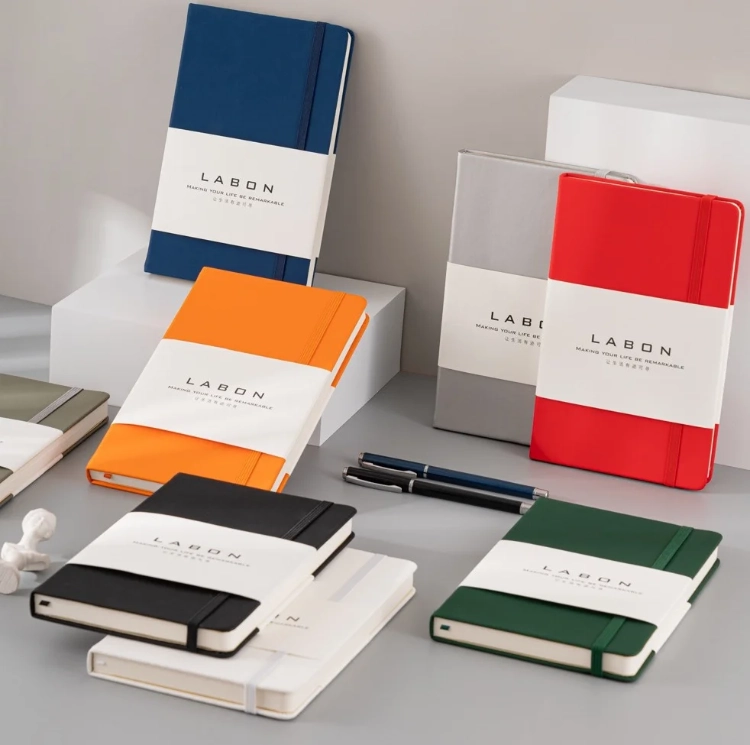
Labon’s product range includes hard notebooks, soft notebooks, coil books, journals, diaries, planners, and custom notebooks. Choose the format that fits the use case and packaging plan. A coil book may support practical page access, while a hard or soft book-like format may suit a journal, retail product, or gift collection.
The Classic Luxury PU Notebook is an official reference for a structured PU notebook direction. Use it as a starting point for discussion, then confirm the exact custom specification rather than assuming the reference product is identical to the planned order.
Step 4: Request a Quote and Production Sample
After the brief is complete, request a quotation and sample plan. Ask the quotation to separate the notebook, printing, packaging, accessories, and other required elements so changes can be traced to the part of the specification that caused them.
Labon’s ordering guidance recommends placing a sample order first and placing the large order after sample confirmation. The inquiry-cloud material states that a sample can be completed within 5-7 days per inquiry. Treat that as source-provided guidance and confirm the actual schedule for the selected design, material, quantity, and shipping arrangement.
The sample request should list exactly what must be tested. If paper, page count, cover, binding, printing, or packaging changes after sampling, the quotation and production result may also change. A sample only works as a manufacturing reference when the version being approved matches the version being ordered.
Step 5: Approve the Sample Before Bulk Production
Approve the complete notebook, not only the logo or cover artwork. The sample should prove the physical feel, printing, page construction, binding, and packaging that the bulk order is expected to reproduce.
Check Physical Feel and Binding
Check cover flexibility, surface, weight, page turning, spine or coil, and overall balance. The notebook should feel appropriate for its intended use and market position, and the binding should behave as expected during normal handling.
Check Printing and Artwork
Check logo size, location, color, artwork sharpness, edge clearance, and printed text. Review inner pages as well as the cover. For museum, retail, or corporate projects, verify names, dates, translations, and brand wording before approval so errors are not multiplied during bulk production.
Check Packaging Fit
Place the actual notebook into the actual box or sleeve. Confirm that the product is protected, easy to remove, and presented as intended. Labon supplies gift boxes and gift sets for retail, corporate, anniversary, souvenir, and museum or cultural travel applications.
Record the approval in writing and keep the approved sample, artwork, and final specification together. This creates the reference point for the next stages of the notebook manufacturing process.
Steps 6-7: Bulk Notebook Manufacturing and Quality Control
Once the sample is approved, lock the final order details before bulk manufacturing begins. The purchase record should include the final notebook specification, packaging, quantity, destination, payment terms, approved artwork, and any inspection requirements so the factory is not working from scattered messages or older files.
Labon’s knowledge base describes quality control from raw materials through final production, including performance, durability, safety, and aesthetics. Buyers should still define which details must match the approved sample and which tolerances, substitutions, or corrections require communication before the order is released.
Yiwu Labon Stationery Co., Ltd. was established in 2003 and is headquartered in Yiwu, Zhejiang Province. The supplied materials state that the company focuses on paper notebooks and related paper products, serves customers in 52 countries, and produces 2,320,000 notebooks yearly. These figures are source-provided and should be confirmed for the specific commercial program.
For repeat orders, ask how the approved specification and sample status will be retained. Repeatability depends on a clear record of materials, printing, binding, packaging, and approval decisions, especially when an order is produced again months later.
Step 8: Confirm Payment, Packaging, Shipping, and After-Sale Terms
Before shipment, confirm payment, packaging, labeling, destination, shipping terms, and the final communication route for the order. Labon supports TT and PayPal according to the knowledge base, with payment convenience information for Europe, Hong Kong, and the United States mentioned in the inquiry-cloud material.
The supplied after-sale information states that when problems are caused by Labon’s work, the company may compensate faulty products or provide other solutions according to customer needs. Confirm the order-specific terms, evidence requirements, and response process before production so responsibilities are clear.
How Labon Supports Custom Notebook Manufacturing
Labon’s product scope covers office notebooks, student notebooks, journals, diaries, planners, gift boxes, gift sets, hard notebooks, soft notebooks, coil books, and related paper products. The company can support OEM, ODM, and customized production, and the knowledge base names Archer and Olive, Freedom Mastery, and Anecdote Goods as customer cases. Those names should not be used to imply project details the source does not provide.
For a new buyer, the most useful next step is to send a complete specification and request a sample plan. Start with the existing product portfolio to choose a direction, then define the exact paper, cover, binding, printing, packaging, quantity, and destination that the sample must represent.
Custom Notebook Production Process Checklist
A reliable custom notebook production process follows one sequence: define the use, write the specification, select materials and format, request a quote and sample, approve the complete sample, lock the final files, start bulk manufacturing, inspect quality, and confirm packaging and commercial terms. The approved sample and final written specification should remain the reference throughout production.
FAQ
What is the first step in the notebook production process?
Define the notebook use and write a complete specification covering size, cover, paper, page layout, binding, printing, packaging, quantity, destination, and sample requirements.
Should I approve a sample before bulk notebook production?
Yes. The supplied Labon process recommends a sample order first and a large order after sample confirmation. The approved sample should match the final specification used for bulk manufacturing.
Can OEM or ODM be part of the custom notebook manufacturing process?
Yes. Labon’s knowledge base states that the company supports OEM, ODM, customized production, customer use of Labon designs, and stock-item supply where applicable.
How long can a custom notebook production sample take?
The inquiry-cloud material states that a sample can be completed within 5-7 days per inquiry, but the actual schedule should be confirmed for the specific design, materials, printing, packaging, and shipping plan.
What should be locked before bulk notebook manufacturing starts?
Lock the final product specification, approved artwork, packaging, quantity, destination, payment terms, and any inspection requirements. Keep those records together with the approved sample so production has one clear reference.