
Notebooks are still used today because they are simple to use. Open up a notebook, write a few words, create a list, note the date, sketch an idea and return to it later. No screen. No app. No charging. That is why notebooks still sit on office desks, school tables, hotel counters, museum shelves, meeting rooms, and gift boxes.
For business buyers, the question is not only “What do people use notebooks for?” It is also “Which notebook will they actually keep using?” A cheap notebook may look fine at first, but weak paper, poor binding, or the wrong size can make it useless fast.
Labon works with custom branded notebooks, journals, diaries, planners, and gift sets for buyers who need paper products with a clear use. The company was established in 2003 in Yiwu, Zhejiang, and has more than 20 years of notebook manufacturing experience. Its product range includes regular hard notebook, soft notebook, coil book, note book, and gift boxes. Cover materials can include PU, linen, coated paper, and leatherate paper. Inner paper options can include wood pulp paper, stone paper, coated paper, watercolor paper, and cotton paper. For you, this gives room to match the product with the real user, not just the catalog photo.
What Do Most People Use Notebooks For?
Notebooks are used for taking notes, planning, studying, for meetings, journaling, sketching, making lists and keeping small records. There are many uses for a notebook but the essence of all of them is that people need somewhere to write down their thoughts before they are lost forever.
If you are buying notebooks for a brand, school, event, or retail line, you should group the use first. A meeting notebook, a school notebook, a travel journal, and a gift box set should not be built the same way.
Notes, Plans, and Daily Records
Daily notes are the most common use. People write reminders, phone numbers, meeting points, shopping lists, order details, and short ideas. For this kind of use, a soft notebook or standard hard notebook works well.
Ruled pages are usually the safest choice. They keep writing neat and easy to review. A5 is better when users carry the notebook often. B5 gives more room for longer notes, project points, and class writing.
Work, School, and Creative Ideas
Work and school users need notebooks that can handle repeat use. They may write class notes, meeting records, project plans, revision lists, or training points. A coil book is practical because it opens flat. A hard notebook gives better protection when the user moves between rooms.
Creative users need more open space. Dotted, grid, or blank pages fit sketches, page plans, charts, and product ideas. If the page layout does not fit the task, the user may stop using the notebook even if the cover looks good.
Personal Use, Gift Use, and Brand Use
In addition to business uses for notebooks, people also use them to keep a journal, for travel notes, for recipes, for a reading log, for working out, and for planning with their family. All of these notebooks feel very personal, so we pay a lot of attention to the cover, the color, the paper, and the size of the notebook.
For companies, notebooks also work as long-term brand items. A custom notebook can stay on a desk for months. That makes it useful for employee kits, client gifts, exhibitions, school programs, and company events.
Everyday Notebook Uses and Writing Scenarios
Everyday notebook use is broad. A product that fits everyday use should be easy to open, easy to write in, and easy to carry or store. Too many design tricks can make the notebook harder to use.
This is where you should think less about decoration and more about how the user writes.
Personal Journaling and Reflection
A journal is a book where people write down their thoughts, set themselves goals, store away happy memories and write down private matters. Even though users of such journals do not write every day in the journal, they are very particular about the quality of the notebook.
For journaling, a PU hardcover notebook is a strong choice. It feels stable, protects the pages, and looks suitable for personal use or gift use. Linen covers can work well for a softer style. If you want a premium journal line, paper smoothness and binding strength should not be ignored.
Daily Planning and To-Do Lists
So many use a notebook for their daily planning instead of a printed planner. They jot down their to-do’s, weekly goals, shopping lists, schedules, and reminders in their notebook.
For this use, dotted, grid, or ruled pages can all work. The layout should stay clean. Too many printed blocks can limit the user. If you need a special layout, the production process can help you plan size, material, inner pages, cover customisation, and accessories before sampling.
Travel Notes and Hobby Tracking
Travelers and hobby users record routes, costs, addresses, recipes, garden notes, fitness progress, and reading lists. These notebooks are often carried outside, so they need stronger covers and practical sizes.
A soft notebook is light. A hard notebook protects better. If the notebook is for a museum shop, travel project, or souvenir program, a gift box can make the product feel more complete and easier to sell as a keepsake.
Work, School, and Meeting Note Needs
Work and school notebooks are used often. Users may not talk about binding or paper weight at first, but they notice when pages tear, ink shows through, or the cover bends too fast.
For these cases, the notebook should be practical first. Design should support use, not replace it.
Meeting Notes and Project Records
For meetings, a notebook should look clean and write smoothly. A PU hardcover notebook with logo work is a good fit for client meetings, team records, training sessions, and project discussions.
B5 works well when users need space for action points and diagrams. A5 is better for sales visits and travel. If your logo sits on a notebook that people use every week, your brand gets more real exposure than it would from a short-life handout.
Class Notes and Study Reviews
Students need space, strength, and pages that support fast writing. Coil books and soft notebooks are both practical. Coil books open flat, which helps in class. Soft notebooks are easier to carry in bulk.
Ruled pages are best for general school notes. Grid pages help with math, charts, and science subjects. For training companies or education projects, mixed page designs can be useful.
Brainstorming and Sketch Development
A lot of the people we have met that use Notebooks for brainstorming are from Marketing teams, Designers, Product staff and Small business owners. This is how they use Notebooks for brainstorming: Writing down names, Creating rough layouts, Outlining product points and Sketching out packaging ideas.
Blank pages suit sketches. Dotted pages suit planning. Grid pages suit tables and diagrams. If users may write with markers, thicker paper is safer. If they mainly use ballpoint pens, standard writing paper may be enough.
Notebook Details That Shape Daily Use
A notebook works best when the page, size, cover, and binding match the user. Many buyers start with the logo on the cover, but the inner pages often decide whether people keep using it.
Before sampling, spend a little time on these details. It can save you trouble later.
Ruled, Dotted, Grid, and Blank Pages
Ruled pages suit meetings, school notes, daily writing, and journals. Dotted pages give light structure and work well for planners, habit trackers, and lists. Grid pages fit charts, tables, and technical notes. Blank pages suit sketching and free writing.
A custom notebook line can include several page types. You can check different product directions through our portfolio before you fix the final style.
A5, B5, and Portable Notebook Sizes
A5 is easy to carry and suits daily lists, travel notes, and light journaling. B5 gives more room and works better for meetings, study notes, and project planning. Larger sizes may suit desk use, but they are not always easy to carry.
If your buyer group is mixed, A5 and B5 are usually safer than very small or very large formats.
PU, Linen, and Hardcover Cover Choices
PU covers suit business gifts because they look clean and are easy to brand. Linen covers feel softer and fit lifestyle stationery. Coated paper covers work well for colorful retail designs. A hardcover structure gives better page protection and a more formal hand feel.
For corporate gifting, a PU hardcover notebook or a gift box set is usually more suitable than a casual softcover notebook.
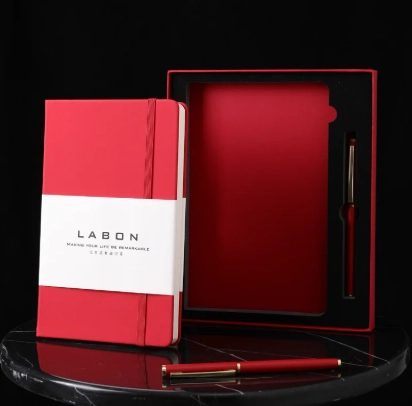
Labon Classic Gift Box for Brand Buyers
A single notebook is useful, but a gift box can raise the product value. This matters when the notebook is used as a company gift, museum souvenir, employee welcome item, or retail set.
The Labon Classic Gift Box is suitable for buyers who want a notebook product with better presentation. It can connect the notebook, packaging, logo, and event purpose in one set. That is useful when the product needs to look more prepared, not like a last-minute giveaway.
Company Anniversary Gift Use
For company anniversaries, the gift needs to feel organized and worth keeping. A notebook inside a classic gift box can carry the logo, anniversary theme, company color, or message card.
This works better than a loose notebook when the recipient is an employee, partner, or long-term client. The box gives the product a clear gift feeling.
Souvenir and Museum Retail Use
For museum shops and souvenir projects, the product should carry a memory. A notebook can hold sketches, travel notes, stamps, and small records. When it comes in a gift box, it feels more like a keepsake.
Labon also supports gift set projects such as souvenir notebook gift set, company anniversary gift set, and museum gift set. This fits buyers who want more than a plain notebook SKU.
Notebook Packaging and Brand Presentation
Packaging should not be the final afterthought. The box color, notebook cover, logo method, paper choice, and accessories should feel like one product.
For retail and corporate buyers, this is important. A good box helps the notebook look ready for gifting, display, storage, and shipping. It also gives your brand more space to show its style without making the notebook itself too busy.
Create Your Custom Gift Box with Labon
If you want a custom notebook or gift box project, start with the user and the use. Is it for work, school, journaling, retail, travel, or gifting? Will the person carry it every day, keep it on a desk, or open it as a gift?
Labon can support OEM and ODM notebook projects, sample development, material selection, cover customization, inner page design, accessories, and gift packaging. You can also read more through about us before you prepare your project brief.
OEM and ODM Custom Support
OEM is suitable when you already have a clear design. ODM is useful when you need style ideas, structure suggestions, or a ready product that can be adjusted.
Before sampling, confirm size, cover material, paper type, page layout, binding, logo method, box structure, and packaging details. Clear information helps the factory quote faster and reduces back-and-forth changes.
Sample, Material, and Logo Confirmation
A sample is not only for checking appearance. Write on the paper. Open the notebook fully. Check the cover, box, logo position, binding, and hand feel.
This step is important for event orders and seasonal retail launches. A good sample helps you find problems before bulk production.
Contact Labon for Gift Box Projects
If you already know your target user, send a clear brief. Include your product purpose, size, paper, cover, logo, packaging, quantity, and timeline.
For direct project discussion, use the contact page. A clear message helps the team recommend the right notebook type faster, whether you need a PU hardcover notebook, soft notebook, coil book, journal, planner, Labon Classic Gift Box, or custom gift set.
Conclusion
Most people use notebooks for notes, plans, study, meetings, journals, sketches, lists, and records. For business buyers, the right notebook should match the user’s writing habit, carrying habit, and use setting.
A5 works for portable use. B5 works for longer notes. PU hardcover notebooks suit meetings and business gifts. Soft notebooks and coil books suit daily writing and study. Gift box sets suit events, anniversaries, museum retail, and client gifts.
A useful notebook gets used. A well-made gift box gets remembered. When the size, paper, cover, layout, and packaging match the real scene, the product feels practical instead of random.
FAQ
Q1: What Do Most People Use Notebooks For?
A1: Most people use notebooks for taking notes, planning tasks, journaling, studying, recording meetings, sketching ideas, and keeping daily information in one place.
Q2: What Type of Notebook Is Best for Work?
A2: A PU hardcover notebook or B5 notebook is usually better for work because it looks professional and gives enough space for meeting notes, project records, and task lists.
Q3: Why Choose a Gift Box Instead of a Single Notebook?
A3: A gift box gives the notebook better presentation and makes it more suitable for company anniversaries, client gifts, museum retail, souvenir programs, and employee gifts.
Q4: What Page Layout Should I Choose for a Custom Notebook?
A4: Ruled pages suit organized writing, dotted pages suit planning, grid pages suit charts and structured notes, and blank pages suit sketches or creative use.
Q5: Is Labon Classic Gift Box Suitable for Brand Buyers?
A5: Labon Classic Gift Box is suitable for brand buyers who need a notebook product with stronger packaging, clearer gift value, and more room for logo and theme design.