Notebook packaging has to do several jobs in a small space. It should protect the product, communicate the most useful selling points, leave room for retail information, and support the brand without hiding the notebook that customers came to see.
Printed belly bands and paper wraps are two practical ways to add that information without printing every detail on the cover. Both can carry a logo, product name, barcode, materials note, gift message, or campaign artwork. Their coverage and assembly, however, are not the same.
The best choice depends on how much of the cover should remain visible, how the notebook will be handled, and whether the package is intended for a retail shelf, corporate event, museum shop, or gift set.
What Is the Difference Between a Belly Band and a Paper Wrap?
A notebook belly band is a narrow printed strip that circles part of the product. A paper wrap covers more of the surface and may behave like a sleeve or protective outer layer. Buyers should use dimensions and dielines in the brief because packaging terms can vary between suppliers.
Narrow Belly Bands
A narrow band leaves most of the notebook visible. It suits products whose cover material, foil, embossing, illustration, or color is already a strong part of the presentation. The band can hold a concise message and retail details without competing with the cover.
Full or Wide Paper Wraps
A wider wrap creates more printable area and can protect a larger portion of the cover from light handling. It may suit a collection that needs consistent campaign artwork across several notebook colors. The wrap still needs enough clearance to slide on without scratching the product.
Sleeves and Folded Alternatives
A folded paper sleeve can provide greater coverage and a more structured unboxing sequence. It may need more paper, assembly, and dimensional control than a simple band. Compare it with a gift box or individual bag when protection is more important than minimal material.
Branding and Print Area
Start by deciding which information belongs on the permanent notebook and which information belongs on removable packaging. A logo or signature design may stay on the cover, while barcode, campaign copy, care notes, and product specifications can sit on the band.
Keep the front message short enough to scan. Use the reverse or inside area for secondary information. Leave safe space around folds, overlaps, adhesive points, and cut edges. If the wrap includes a barcode or QR code, test it on the final printed stock and curved product.
Plan the hierarchy before designing the dieline. A retail band may lead with the collection name, follow with one clear product benefit, and place the barcode and specifications on the back. A corporate band may lead with the event or recipient message and keep the manufacturer’s information secondary. The available area is limited, so every line should have a job.
Multilingual packaging needs more space and stronger proofreading control. Decide whether languages share one panel, move to the reverse, or use market-specific versions. Keep legal or recycling statements readable at the final printed size. Do not shrink important text to make an existing design fit a narrower band.
Variable information can affect the printing plan. Individual names, event dates, product codes, or regional barcodes may require digital printing, labels, or separate versions. Confirm how the variable area will be produced and inspected before approving a design that depends on personalization.
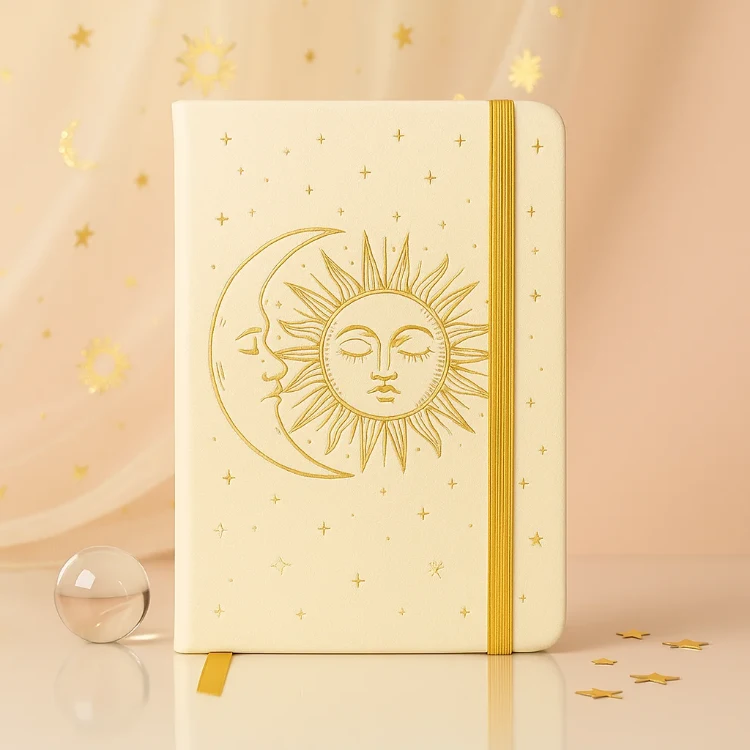
The Celestial Light Notebook is an official visual reference for a design-led notebook cover. A belly band for a cover of this kind should complement the visible artwork rather than conceal it. The product page does not establish a packaging specification for a new project.
Material and Finish Choices
Paper weight affects how the band feels and how easily it wraps. A stock that is too light may curl or tear. A stock that is too stiff may spring open, crease poorly, or put pressure on soft cover edges. Request a dummy around the real notebook before approving the material.
Paper Structure and Grain
Grain direction affects how cleanly a band folds and wraps. Paper usually bends more easily with the grain, so an unsuitable orientation can create cracking, spring-back, or uneven edges. Show the finished band direction on the dieline and ask the converter to confirm the grain plan for the selected sheet.
Compare opacity when the band crosses a dark or patterned cover. A light stock may allow the artwork underneath to show through and change printed colors. A denser or lined paper can improve coverage, but it also changes stiffness and cost. Test the actual band on every notebook color in the range.
Surface Finish and Rub Resistance
Coating, varnish, or lamination can protect print, but the finish changes touch and recyclability. A matte surface may support a quiet retail look, while gloss can intensify photographs and color. Uncoated stock can feel natural but may show handling marks more quickly, especially around light colors and folded edges.
Run a simple rub test against the notebook cover and adjacent packed units. Foil and heavy ink areas should not transfer, scratch, or leave residue. If the product will be handled repeatedly on a shelf, test more than a freshly packed sample.
Adhesive and Locking Methods
A glued overlap creates a clean continuous band when the adhesive and curing time are controlled. A tab or locking cut can avoid glue but may add tooling and assembly steps. Removable tape can help short runs, provided it never touches or marks the notebook itself.
Place the closure where it does not interrupt key copy or sit on a prominent cover detail. Specify overlap tolerance and test whether the joint opens during temperature changes or transport. For premium products, inspect the back as carefully as the front because a crooked seam can weaken the presentation.
Uncoated paper can provide a natural feel and accepts many printing approaches. Coated paper can support crisp images and strong color. Specialty texture, foil, embossing, or die cutting can add impact, but every finish should serve a clear branding purpose and survive normal packing and handling.
Color matching deserves attention when the band sits directly against the notebook. A near match can look accidental, while a deliberate contrast is easier to control. Review the band, cover, elastic, ribbon, and box together under the same lighting.
The Labon Notebook Builder provides a practical starting point for aligning the notebook format and cover direction before the packaging dieline is finalized. The band dimensions should then be calculated from the approved physical notebook.
Sustainability claims must be specific and supportable. State the actual paper, coating, certification, recycled content, or disposal instruction that has been confirmed. Avoid broad environmental claims based only on the fact that the package is made from paper.
Packing and Production Checks
The dieline should include the finished band size, fold positions, overlap, grain direction, adhesive area, bleed, safe area, and tolerances. Confirm whether the band is glued, locked, taped, or simply wrapped. Adhesive must not reach or mark the notebook cover.
Test assembly speed before bulk production. A beautiful structure that takes too long to fit may add packing cost or create inconsistent alignment. The band should stay in place during carton packing and transport while remaining easy for the customer to remove.
Create an assembly reference with photographs or a signed sample showing front alignment, overlap position, and acceptable movement. Operators need one clear standard, especially when the band must line up with cover artwork. Check units from the start, middle, and end of a packing run rather than reviewing only the first carton.
Carton compression can shift or crease a loose band. Pack the final number of units with the intended orientation, dividers, and protective materials. After a handling test, inspect corners, folds, print surfaces, and band position. If movement remains a problem, adjust fit or inner packing instead of relying on excessive adhesive.
Define inspection points that can be checked without subjective language. These can include front-panel position, maximum skew, overlap width, joint security, fold cracking, scuffing, barcode readability, and ease of removal. Measure a small sample across more than one carton and record the result against the signed packaging sample. When several notebook colors share one band structure, test every cover surface because friction and color show-through may differ.
Retail handling deserves a separate trial. Place finished units upright, flat, and in a display stack, then remove and replace them several times. A band that survives shipping may still slide on a smooth cover or tear when customers handle it. If the barcode sits across a curve or overlap, scan it on the packed notebook rather than approving it only from flat artwork.
Check scuffing, cracking at folds, ink transfer, foil damage, and movement around the notebook. Pack several finished samples into the intended carton and simulate ordinary handling. If the product includes a pen, card, or accessory, make sure the band does not become the only feature holding loose parts together.
Labon’s published production process can help frame the movement from design and sample approval into production. The final packaging dieline, material, assembly method, and packing test still need project-specific confirmation.
Develop Notebook Packaging With Labon
Labon Stationery produces paper notebooks and related paper products and supports customized production, OEM, and ODM. Its stated range includes hard notebooks, soft notebooks, coil books, journals, diaries, planners, gift boxes, and gift sets, allowing the package to be discussed with the notebook rather than as a separate afterthought.
The knowledge base lists PU, linen, coated paper, and leatherate paper among cover directions. It also describes bespoke retail and corporate packaging, souvenir notebook gift sets, company anniversary gift sets, and museum gift sets. Those capabilities make the intended channel and unboxing experience important parts of the brief.
Labon’s product scope also includes gift boxes and gift sets. Buyers can therefore compare a belly band or wrap with a boxed presentation using the same notebook specification. The lighter format may suit shelf visibility and efficient replenishment, while a box may be justified when protection, accessories, or a formal presentation is central to the program.
Review the Labon product portfolio and identify the cover structure closest to the planned item. Then send the notebook dimensions, band or wrap dieline, stock, printing, finish, barcode, assembly method, individual packing, quantity, and destination through the Labon contact page. Approve the band on the final notebook sample before bulk packing begins.
Conclusion
A belly band is best when the notebook cover should remain visible and the packaging message is concise. A wider paper wrap or sleeve offers more printable area and coverage but requires tighter control of folds, fit, and assembly. Choose the structure after placing it around the real notebook, then test print quality, movement, protection, and packing speed as one finished system.
FAQ
What Is a Notebook Belly Band?
A notebook belly band is a printed strip that wraps around part of the product to carry branding, retail information, or a campaign message.
Is a Paper Wrap the Same as a Belly Band?
Not always, because a paper wrap may cover more of the notebook or use a sleeve-like structure, so the dieline should define the exact format.
What Information Should Go on a Notebook Belly Band?
Common content includes the product name, logo, short benefit, barcode, materials note, care information, or campaign message.
How Tight Should a Notebook Belly Band Be?
It should stay aligned during handling without scratching, compressing, or bending the notebook, which is best verified on a physical sample.
Can Notebook Belly Bands Use Foil or Embossing?
Yes, when the selected stock and structure support the finish, but fold cracking, rubbing, alignment, and production cost should be tested first.