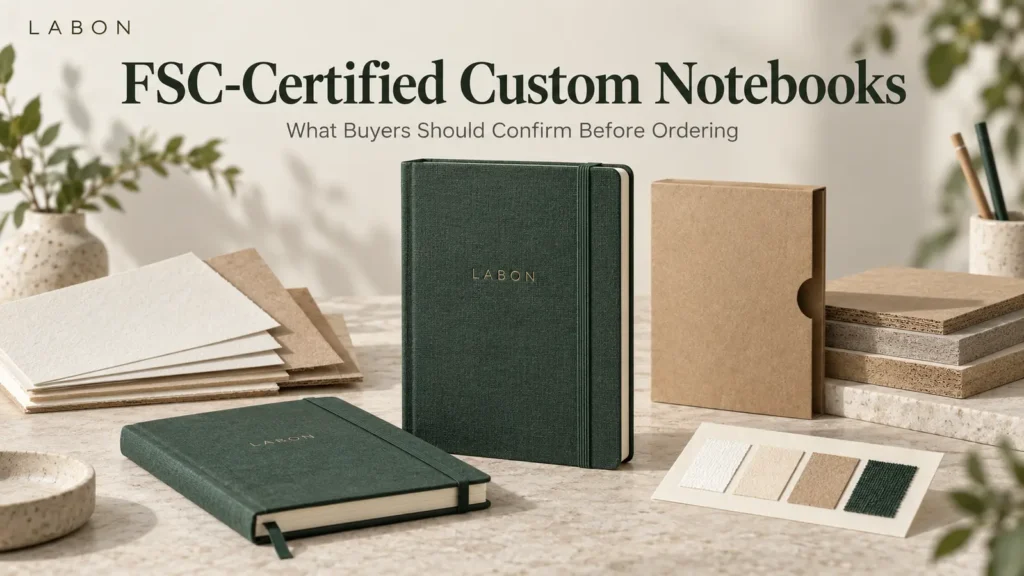
“Use FSC paper” is not yet a production-ready brief. In a private-label notebook order, a buyer may need a visible FSC label, a claim on order documentation, or simply an FSC paper option. Those requests are related, but they do not follow the same approval path.
The practical question is whether the materials, certified supply chain, artwork and documents line up for your exact SKU. This guide helps buyers prepare an FSC-certified notebook, journal, planner or paper-based gift set. It is not a substitute for a decision by an FSC certification body.
Why “FSC-certified” is more than a paper specification
FSC chain-of-custody certification is designed to identify and track certified forest-based materials through production and distribution. Certificate holders keep records relating to the purchase, production and sale of certified products. An FSC request is therefore both a material decision and a traceability decision.
A mill name, paper swatch or logo on a mock-up is not enough by itself. A premium notebook may include text paper, endpapers, greyboard, a paper sleeve, a rigid box and printed inserts. Define which components are part of the intended claim, then have the relevant certificate holder confirm what can be supplied and how it can be described. FSC’s chain-of-custody guidance explains the underlying system.
1. Define the outcome before asking for a quote
Write one clear sentence in the project brief: “The A5 journal and its paper sleeve must be supplied with the agreed FSC claim and label treatment for the UK retail launch.” That is more useful than “eco-friendly notebook” or “FSC paper preferred.”
Then decide which outcome you actually need:
- A visible FSC label on the notebook, its packaging or both.
- An FSC claim on order documentation for a retailer or internal compliance file.
- An FSC paper option without an FSC-labelled finished-product claim.
These choices affect artwork, approvals and documentation. A notebook, paper insert and rigid box should not be treated as interchangeable simply because they ship together.
2. Map the forest-based components, not only the text paper
Ask the supplier to list the paper and board components in plain language: text paper, endpapers, cover paper where used, greyboard in a casebound cover, sleeves, carton inserts and gift-box board. If a component is not intended to be covered by the claim, record that rather than assuming it is.
Premium notebooks are rarely one material. A cloth- or PU-covered case can contain greyboard, while a gift box may use a different board grade. Foil, elastic, ribbon, magnets and metal parts are separate materials and should not be presented as though an FSC paper claim automatically applies to them. This mapping also makes a proposed paper, board or packaging substitution visible before it becomes a production change.
3. Verify the certificate and the project-specific scope
A supplier should be able to identify the legal certificate holder and current certificate information relevant to the order. Public certificate checks are useful, but the key commercial step is confirming that the proposed notebook and requested claim fit the supplier’s certified workflow.
Do not ask only for “an FSC certificate.” Ask:
- Which company will issue the applicable FSC claim for this order?
- Which paper and board components are included?
- What claim or label treatment is proposed for the finished SKU?
- Which document will identify the claim if a retailer requires it?
A certificate is evidence of an organisation’s system, not a blank approval for every material, artwork file or product variation. Include the product name, SKU, destination market and claim requirement so the answer relates to the item you are buying.
4. Treat the FSC label as approved artwork, not decoration
If the notebook or packaging will carry an FSC label, decide its location before the dieline and cover layout are locked. It needs a clean, readable space that will not be hidden by a belly band, barcode, shrink wrap or insert. For a gift set, the outer box or sleeve may be more practical than the book cover, but placement must follow the approved claim and final presentation.
Do not redraw the logo, reuse a licence code from a previous project or treat a supplier’s label asset as a generic design file. FSC states that only authorised certified companies can place FSC labels on products, and the label must match the product claim. Use the current approved artwork and retain that approval with the production file.
5. Put the claim into the purchase order and sample record
Make the FSC requirement visible to your factory, purchasing team and quality inspector. A practical purchase-order note identifies the SKU, components included, claim or label treatment, artwork version and any document expected at shipment. It should also require written approval before a relevant material or label change is made.
This matters when one order contains a notebook, a boxed edition and an FBA-ready bundle. They may share a cover but have different packaging. For a broader release check, use this custom notebook sample approval checklist; it keeps paper, binding, finishing and packout in one approval record.
6. Approve a physical sample with the real packout
A digital proof can confirm position, but it cannot show whether the finished product still feels considered once packed. Review the notebook with its actual sleeve, box or wrap. Check label readability, packaging fit, cover protection and whether the unit can be assembled consistently.
At the same time, test the paper in the bound notebook. Handling the finished object reveals opacity, surface feel, print density and writing behaviour that a loose swatch cannot. Our guide to paper specification for premium custom journals covers the writing and print checks worth recording. Marketplace orders should also test barcode space, set integrity and protective packaging; see Amazon FBA notebook preparation.
7. Keep FSC claims separate from broader sustainability claims
FSC is meaningful, but it is specific: it addresses forest-based materials and the chain of custody behind an eligible claim. It does not by itself prove every environmental attribute of a notebook, recycled content in every component or social compliance across every supplier.
Use equally precise language. If your marketing says “FSC-certified paper,” make sure the order and product support that wording. Verify recycled content, recycled packaging, material safety and social-audit information separately. Specific claims are more credible than a broad “sustainable notebook” statement that cannot be traced to a component or document.
A short FSC sourcing checklist for custom notebooks
- State whether you need an FSC paper option, an order-document claim, an on-product label or a packaging label.
- Identify every forest-based component included in the claim.
- Confirm the relevant certificate holder and project-specific workflow.
- Reserve label space before finalising cover and packaging artwork.
- Record the approved material, claim, label file and SKU in the purchase order.
- Approve a physical sample with final packout, not separate components.
- Require written reconfirmation if a relevant material or packaging change is proposed.
FAQs
Can a notebook be marketed as FSC-certified if only the paper is FSC?
Do not assume so. The correct wording depends on the certified supply chain, product scope and approved claim or label. Describe the specific paper or finished product only as the relevant certificate holder confirms.
Should I add an FSC logo after bulk production?
No. Plan any label before artwork approval. It must use the correct approved treatment and should be checked on the finished product or packaging.
Do I need a sample for an FSC notebook order?
Yes, especially for a premium journal or gift set. A physical sample verifies paper, construction, label placement and packaging fit together.
Planning an FSC-conscious notebook, journal or paper-based gift set? Send your size, quantity, destination market and claim requirement. LABON can turn the brief into a clear material, sample and production plan.